Table of Contents
- A Nation Rebuilding After Dictatorship
- How Syria Chose Its New Parliament—Without a Public Vote
- Who Actually Won? The Rise of Sunni Revolutionaries
- Women and Minorities Left Behind
- What Comes Next? President al-Shara’s Crucial Appointments
- Sources
A Nation Rebuilding After Dictatorship
Ten months after the fall of Bashar al-Assad’s decades-long regime, Syria has taken its first major political step: forming a new parliament. But this historic moment comes with contradictions. While many Syrians celebrate the end of authoritarian rule, the process itself—marked by the absence of a public vote and limited representation for women and minorities—has raised serious questions about the country’s democratic future.
How Syria Chose Its New Parliament—Without a Public Vote
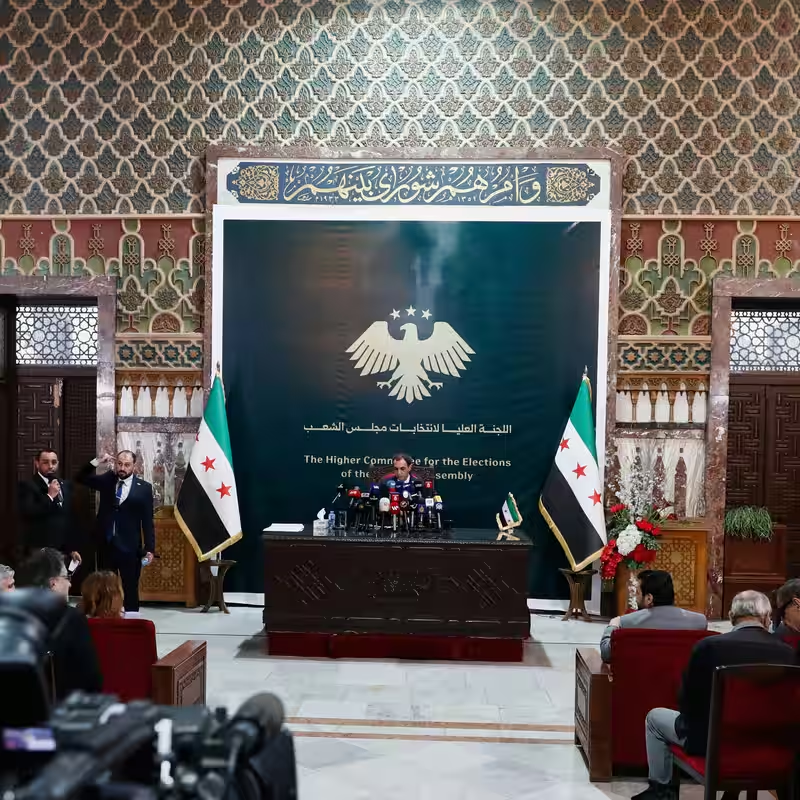
In a move that surprised international observers, Syria’s new government opted against holding a direct popular election. Citing “significant administrative challenges”—including widespread displacement and lack of identification documents—the transitional administration led by President Ahmed al-Shara instead empowered local councils to select 140 of the 210 parliamentary seats.
The remaining 70 seats will be appointed directly by President al-Shara in the coming weeks, a provision that could reshape the assembly’s balance. According to the electoral committee, voting was not held in Kurdish-majority northeastern Syria or the Druze-dominated Sweida province, as those areas remain outside central government control.
Who Actually Won? The Rise of Sunni Revolutionaries
Of the 119 seats announced so far, the vast majority went to Sunni Muslim men who actively fought in the anti-Assad revolution. This outcome reflects both Syria’s demographic reality and the deliberate structure of the electoral system, which favored battle-tested revolutionaries over technocrats or civil society figures.
Among the notable winners:
- A frontline doctor from Idlib who ran a wartime hospital
- A female novelist known for her searing accounts of life under siege
- Several former rebels now returning from displacement in northwestern Syria
“There is no way they are going to choose someone who was not standing on the front line,” said Mona Abu Athan, a Damascus-based candidate who did not secure a seat.
Sunni Dominance Sparks Concerns
Political activist Nabieh Nabhan from Tartus warned that the results may signal the rise of “Sunni nationalism,” potentially sidelining Syria’s rich mosaic of ethnic and religious communities—including Alawites, Christians, Kurds, and Druze.
Women and Minorities Left Behind
Despite promises of inclusive governance, representation remains starkly unequal:
| Group | Seats Won (out of 119 announced) |
|---|---|
| Women | 6 |
| Religious/Ethnic Minorities | Less than 12 |
| Christians | 1 |
Women candidates, many running for the first time, struggled to coordinate or rally behind consensus figures. “We are so new to the experience and the men were organized,” admitted Abu Athan.
What Comes Next? President al-Shara’s Crucial Appointments
All eyes are now on President Ahmed al-Shara. His upcoming appointment of 70 additional lawmakers offers a critical opportunity to correct imbalances and fulfill his pledge of representative government.
International observers and human rights groups have already flagged concerns over recent sectarian violence under the new administration. How al-Shara uses his appointment power could determine whether Syria moves toward pluralism—or entrenches a new form of majoritarian rule.
Still, many activists see this parliament as a vast improvement over the Assad-era legislature, which functioned as little more than a rubber stamp. “People are beginning to understand the mechanics of politics,” said Abdullah al-Hafi of the Local Administration Councils Unit. “Communities once excluded are now learning to play the political game.”
Sources
Syria Chooses a Parliament of Revolutionaries – The New York Times