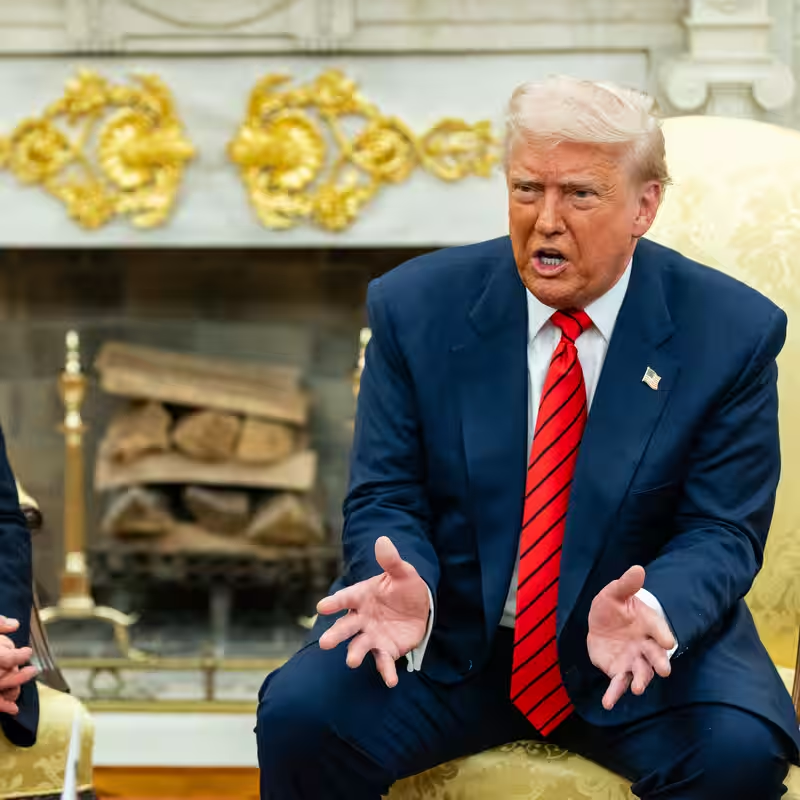
On Tuesday, Canadian Prime Minister Mark Carney walked into the Oval Office for a tense, high-stakes meeting with President Donald Trump—his second face-to-face with the U.S. leader since taking office. The mission? To plead for relief from sweeping American tariffs that are hammering Canadian industries from auto manufacturing to softwood lumber. But despite the diplomatic overtures, few insiders expect Trump to budge.
Table of Contents
- What Are the Tariffs Hitting Canada?
- Why Trump Imposed These Tariffs
- Economic Impact on Canada
- Carney’s Diplomatic Challenge
- What Happens Next?
- Sources
What Are the Tariffs Hitting Canada?
The U.S. tariffs on Canada aren’t a single policy—they’re a patchwork of trade penalties layered over the past year. While most Canadian goods still flow tariff-free under the USMCA (the updated NAFTA deal), key sectors have been singled out:
| Product | Tariff Rate | Justification Cited |
|---|---|---|
| Automobiles | 25% | National security |
| Steel | 25% | National security |
| Aluminum | 10% | National security |
| Softwood Lumber | Up to 18% | Unfair subsidies |
| General Canadian Exports | 35% (selective) | Migration & fentanyl claims |
Notably, the blanket 35% tariff applies only to non-USMCA-compliant goods—a relatively small slice—but the targeted tariffs on autos and metals are hitting core Canadian industries hard.
Why Trump Imposed These Tariffs
President Trump has justified the tariffs using two controversial claims: that Canada is a “major source” of illegal migrants and fentanyl entering the U.S. However, U.S. Customs and Border Protection data shows less than 2% of apprehended migrants at the southern border list Canada as their point of origin—and fentanyl seizures overwhelmingly trace back to Mexico and China, not Canada.
Still, Trump has doubled down, framing the tariffs as “national security necessities.” This echoes his first-term playbook, where steel and aluminum tariffs were similarly defended under Section 232 of the Trade Expansion Act—a rarely used provision meant for wartime threats, not peacetime trade disputes.
Economic Impact on Canada
The fallout is already visible on factory floors:
- General Motors announced 2,000 layoffs at its Oshawa, Ontario pickup-truck plant.
- Stellantis suspended a $3.6 billion overhaul of its Brampton facility, halting plans to produce a new Jeep model.
- Lumber mills in British Columbia have cut shifts, citing collapsed U.S. demand due to punitive duties.
“These aren’t abstract trade numbers—they’re people’s livelihoods,” said Sarah Chen, an economist at the University of Toronto. “When Trump calls it ‘national security,’ he’s masking what’s essentially economic coercion.”
Carney’s Diplomatic Challenge
Unlike his predecessors, Prime Minister Carney—a former central banker with a calm, data-driven style—is navigating a relationship with Trump that’s unusually transactional. His team entered Tuesday’s meeting with modest goals: not a full trade deal (which Canada has failed to secure where others succeeded), but perhaps a carve-out for autos or a pause on new lumber duties.
Yet expectations remain low. “Trump respects strength, but Carney’s strength is in quiet competence—not bluster,” said Michael Froman, former U.S. Trade Representative. “That mismatch makes breakthroughs unlikely.”
Adding to the tension: Trump has repeatedly praised Canada’s natural resources while criticizing its “weak” border policies—a contradiction Carney has struggled to reconcile in public statements.
What Happens Next?
If no relief is granted, Canada may escalate through the USMCA dispute mechanism or impose retaliatory tariffs on U.S. agricultural goods—a move that could hurt American farmers in swing states like Wisconsin and Pennsylvania just months before the 2026 midterms.
For now, all eyes are on the White House readout. Will Trump offer a symbolic concession—like delaying the next lumber duty review? Or will Carney return to Ottawa empty-handed, forced to explain to voters why Canada remains the only G7 nation without a trade understanding with Washington?