Table of Contents
- Aid Flow Increases After Ceasefire
- Food Arrives—But Who Can Afford It?
- Commercial Goods vs. Humanitarian Aid
- Price Drops Aren’t Enough
- The Human Cost of Scarcity
- What Needs to Change
- Sources
Aid Flow Increases After Ceasefire
Since a fragile cease-fire took hold in late October 2025, the number of aid trucks entering Gaza has risen significantly. According to the United Nations Office for the Coordination of Humanitarian Affairs (OCHA), daily entries have jumped from fewer than 100 during active hostilities to over 500 per day in recent weeks.
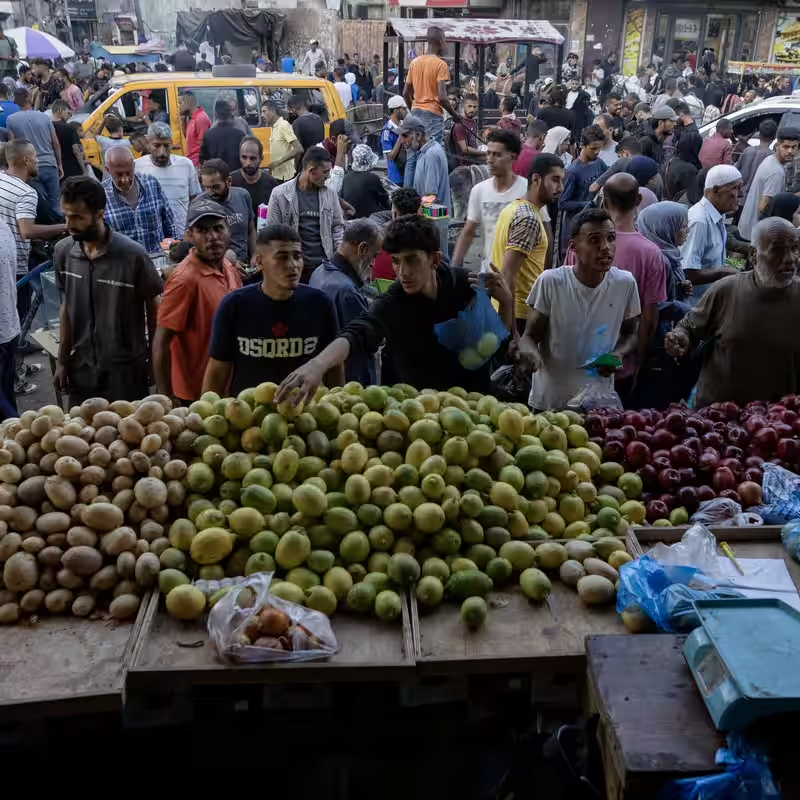
On the surface, this surge suggests progress. Warehouses are filling, bakeries are reopening, and basic staples like flour, rice, and cooking oil are reappearing on shelves. But beneath the headlines, a harsh reality remains: for most of Gaza’s 2.3 million residents, access to food is still dictated not by availability—but by affordability.
Food Arrives—But Who Can Afford It?
While humanitarian organizations like the World Food Programme (WFP) and UNRWA continue to distribute free rations, they account for only a fraction of the goods entering Gaza. The majority of trucks now rolling through the Kerem Shalom and Rafah crossings carry commercial cargo—food and household items meant for sale, not donation.
“Yes, there’s more food,” said Dr. Lina Al-Masri, a public health researcher based in Khan Younis. “But if you’ve lost your job, your home, and your savings—and you’re living in a tent—how do you buy it?”
Commercial Goods vs. Humanitarian Aid
Data from OCHA shows that as of October 28, 2025, roughly 60% of incoming trucks contained commercial goods, while only 25% carried humanitarian aid. The rest included fuel, medical supplies, and construction materials.
This shift reflects Israel’s policy of allowing “normalization” of trade under the ceasefire—but without addressing the economic collapse that has left over 80% of Gazans unemployed and reliant on aid.
“Commercial imports are not a substitute for humanitarian assistance,” warned Philippe Lazzarini, UNRWA Commissioner-General. “They assume a functioning economy. Gaza’s economy is in ruins.”
Price Drops Aren’t Enough
Prices for basic goods have fallen since the ceasefire—wheat flour is now 40% cheaper than in September, and cooking oil has dropped by nearly half. But even at reduced rates, a bag of flour costs the equivalent of a day’s wages for those lucky enough to have work.
For families surviving on $1–2 per day, these “discounts” are meaningless. Many report skipping meals or watering down soup to stretch supplies. In displacement camps across central Gaza, malnutrition rates among children under five remain alarmingly high.
The Human Cost of Scarcity
Despite the increased flow of goods, hospitals continue to treat cases of acute malnutrition. Aid workers describe scenes of mothers trading jewelry for baby formula and teenagers scavenging for discarded food near markets.
“We’re not out of the woods,” said Mahmoud Abu Sitta, a logistics coordinator with the Palestinian Red Crescent. “More trucks don’t equal more food on tables if people have no money to buy it.”
What Needs to Change
Humanitarian groups are urging donors to increase cash assistance programs and expand direct food distribution. They also call for unfettered access for aid convoys and the lifting of restrictions on essential items like seeds, fertilizer, and water purification tools—critical for long-term recovery.
“Aid isn’t just about calories,” said Sarah Al-Najjar, a Gaza-based nutritionist. “It’s about dignity. Right now, people are choosing between feeding their children or buying medicine. That’s not recovery—that’s survival.”