North Korea has dispatched a high-level delegation directly from Pyongyang to the United Nations General Assembly for the first time since 2018—marking a significant diplomatic shift as relations between Kim Jong-un and President Donald Trump show signs of revival. The move signals Pyongyang’s willingness to re-engage on the global stage, even as it continues to expand its nuclear arsenal.
Why This Delegation Matters
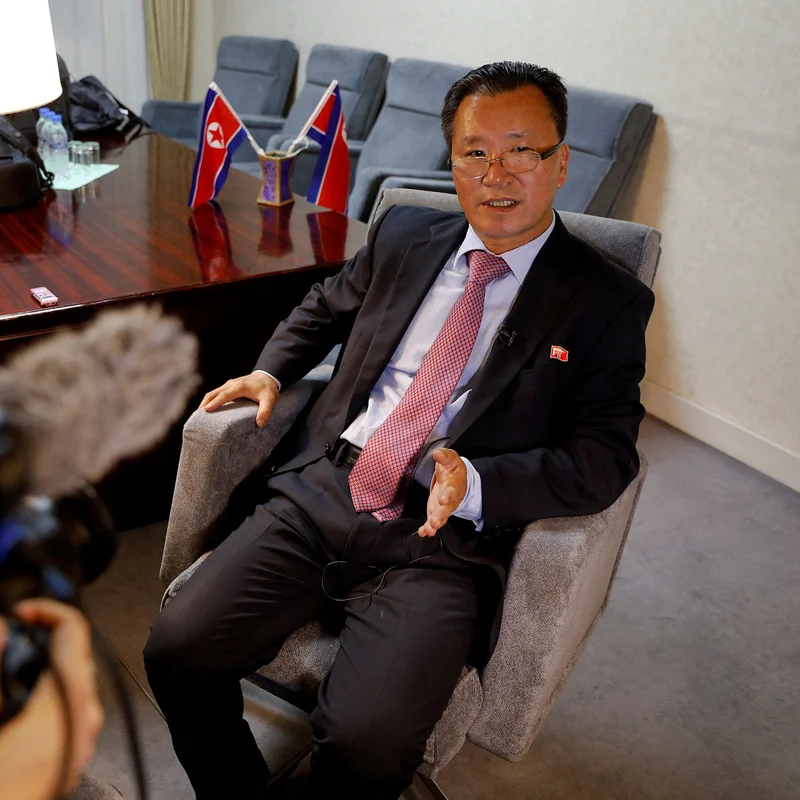
On September 26, 2025, North Korean Vice Foreign Minister Kim Son-gyong arrived in New York to address the UN General Assembly—a rare appearance by a senior official traveling straight from the capital. The last such visit occurred in 2018, during the brief window of U.S.-North Korea diplomacy that included historic summits between Kim and then-President Trump [[NYT]].
Now, with Trump back in the White House and both leaders exchanging unusually warm rhetoric, analysts see this as a potential opening for renewed dialogue—albeit on Pyongyang’s terms.
“I am willing to resume dialogue with the United States as long as Washington stops demanding our denuclearization.”
— Kim Jong-un, September 22, 2025 [[NYT]]
Timeline: North Korea’s UN Engagement Since 2018
While North Korea maintains a permanent mission at the UN, sending top officials from Pyongyang is a deliberate political signal:
- 2018: Foreign Minister Ri Yong-ho attends UNGA—peak of Trump-Kim diplomacy.
- 2019–2024: Only lower-level UN mission staff represent Pyongyang; no capital-based delegations.
- September 2025: Vice Foreign Minister Kim Son-gyong returns—first direct delegation in 7 years.
What’s Changed? The Trump Factor
Since Trump’s re-election, he and Kim have resumed personal correspondence, with Trump calling Kim “a smart leader who wants peace” and Kim praising Trump’s “pragmatic approach.” This contrasts sharply with the Biden administration’s policy of “strategic patience,” which yielded no breakthroughs.
Crucially, Trump has signaled openness to a deal that stops short of full denuclearization—potentially accepting a freeze on missile tests in exchange for partial sanctions relief.
| Issue | U.S. Position (Biden Era) | U.S. Position (Trump 2.0) |
|---|---|---|
| Denuclearization | Non-negotiable precondition | Open to phased talks |
| Sanctions | Maintain full pressure | Possible partial rollback |
| Diplomatic Tone | Formal, cautious | Personal, deal-oriented |
North Korea’s Growing Nuclear Threat
Even as it reaches out diplomatically, Pyongyang has accelerated its weapons program. According to South Korean President Lee Jae-myung, North Korea now possesses:
- ✅ Enough nuclear warheads to ensure regime survival
- ✅ Solid-fuel ICBMs capable of reaching the U.S. mainland
- ✅ Tactical nuclear weapons for battlefield use
7 Years
Since last Pyongyang-led UN visit
Trump-Kim Talks
Resuming after 2019 collapse
ICBM Range
Now covers all of U.S.
What This Means for North America
For U.S. and Canadian readers, North Korea’s return to the UN isn’t just symbolic—it’s a potential inflection point. If Trump and Kim restart talks, it could reduce the risk of miscalculation or escalation on the Korean Peninsula. However, any deal that legitimizes North Korea’s nuclear status may unsettle U.S. allies like Japan and South Korea.
Moreover, a U.S.-North Korea rapprochement could complicate efforts to counter Chinese influence in the region, as Pyongyang remains a key Beijing ally.
For deeper analysis on nuclear diplomacy, see our feature on [INTERNAL_LINK:north-korea-nuclear-strategy].
For official U.S. policy on North Korea, visit the U.S. Department of State – North Korea Page.