Table of Contents
- The Quiet Crisis in Harvard Classrooms
- What the Internal Report Revealed
- Why Students Aren’t Speaking Up
- How Professors Are Fighting Back
- What This Means for Elite Education
- Sources
The Quiet Crisis in Harvard Classrooms
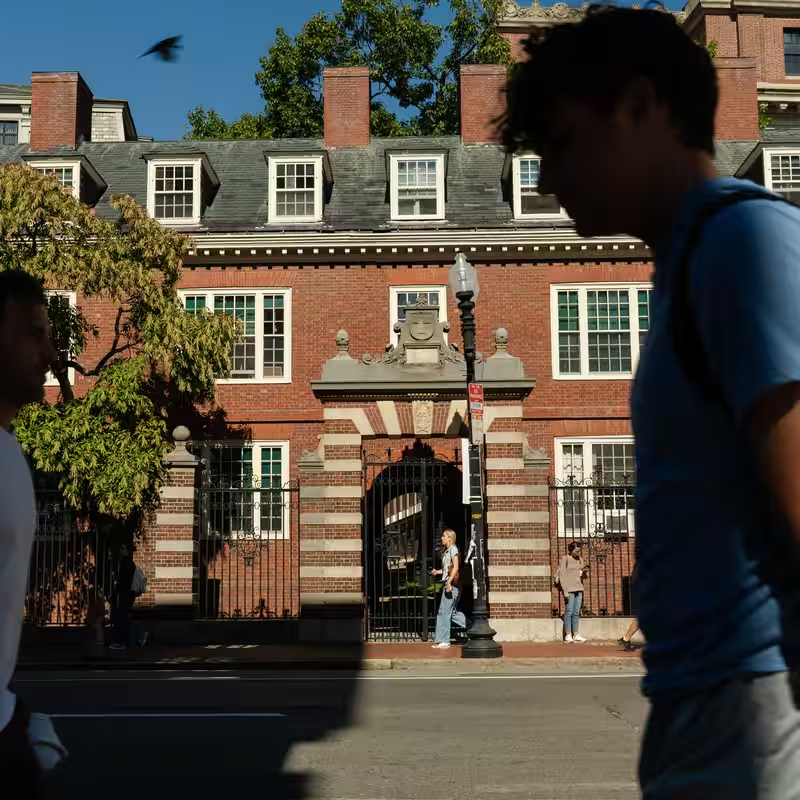
At one of the world’s most prestigious universities, a different kind of crisis is unfolding—not in lecture halls packed with protestors, but in the unsettling silence of students who show up but don’t engage. According to a new internal report, many Harvard undergraduates are skipping the reading, staying quiet during discussions, and treating seminars more like spectator events than intellectual exchanges.
This trend—dubbed “passive attendance”—has alarmed faculty members who say it’s eroding the quality of classroom discourse and undermining the very purpose of a liberal arts education.
What the Internal Report Found
The recently circulated faculty report paints a sobering picture of student behavior across departments:
- Nearly 60% of professors observed students regularly arriving unprepared for class.
- Over half noted a “significant decline” in voluntary student participation over the past five years.
- Many students admitted they “rarely or never” complete assigned readings unless a quiz is scheduled.
One sociology professor described the dynamic bluntly: “It’s like teaching into a void. You ask a provocative question, and 70 eyes look down at their laptops or phones.”
Harvard’s Engagement Gap by Course Type
| Course Type | % of Students Consistently Prepared | Avg. Voluntary Comments per Class |
|---|---|---|
| Small seminars (<15 students) | 42% | 3.1 |
| Lecture courses (>100 students) | 28% | 0.7 |
| Required core classes | 35% | 1.9 |
Why Students Aren’t Speaking Up
Interviews with students reveal a mix of academic, social, and psychological factors:
- Fear of saying the “wrong” thing: In an era of heightened campus sensitivity, some students worry their views might be misinterpreted or criticized.
- Over-scheduling: Many juggle internships, research, extracurriculars, and part-time jobs—leaving little time for deep reading.
- Grade-focused mindset: “If it’s not on the exam, why read it?” said one junior majoring in economics.
- Zoom hangover: Remote learning during the pandemic normalized passive consumption of lectures—a habit that’s hard to break.
How Professors Are Fighting Back
In response, Harvard faculty are experimenting with new strategies to reignite engagement:
- “Cold-calling with care”: Professors now give advance notice before calling on students, reducing anxiety while encouraging preparation.
- Reading reflections: Short, low-stakes written responses due before class.
- Participation portfolios: Students track their own contributions and set weekly goals.
- Anonymous polling: Real-time digital tools let students share thoughts without fear of judgment.
“We’re not trying to shame students,” said Dr. Elena Martinez, a history professor leading the initiative. “We’re trying to rebuild a culture where curiosity—not just compliance—drives learning.”
What This Means for Elite Education
Harvard’s struggle reflects a broader trend across elite institutions. At Yale, Princeton, and Stanford, similar concerns about disengagement have surfaced. Critics argue that elite colleges have become credential factories—where students chase résumé lines over intellectual risk-taking.
If even Harvard can’t guarantee classroom engagement, the question becomes: what does a $80,000-a-year education actually deliver?
Sources
The New York Times: Harvard Has Identified Another Problem: Its Own Students