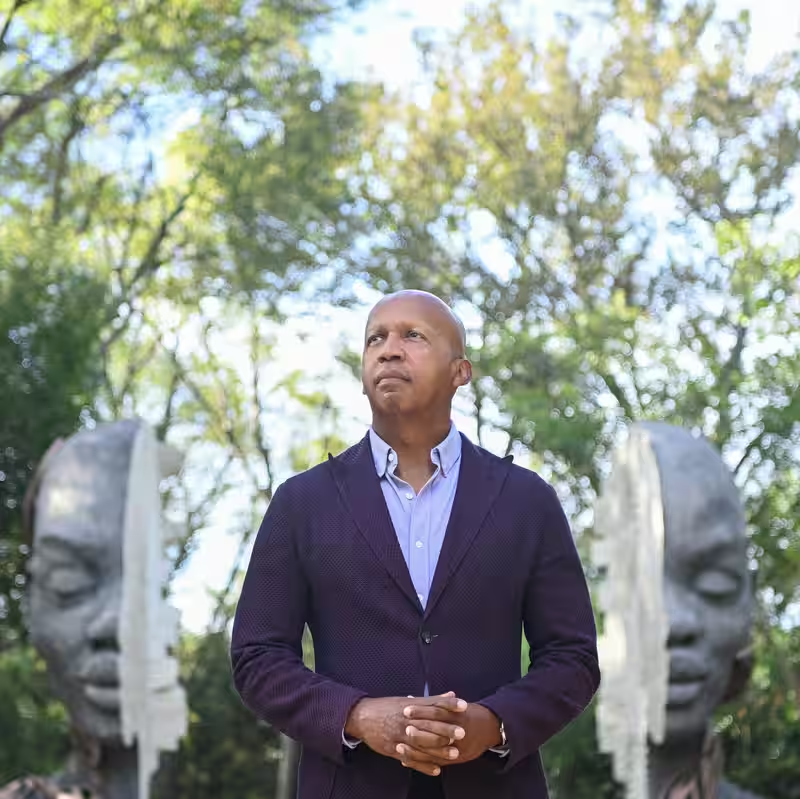
Bryan Stevenson, the renowned civil rights attorney and founder of the Equal Justice Initiative (EJI), has issued a powerful rebuke against President Donald Trump’s recent actions targeting America’s historical narrative. In the face of an executive order aimed at purging “improper, divisive, or anti-American ideology” from Smithsonian museums, Stevenson declared it would be nothing short of “dishonorable” to remain silent .
Why Bryan Stevenson’s Voice Matters Now More Than Ever
Stevenson isn’t just a lawyer—he’s a moral compass for a nation grappling with its past. His work, immortalized in the book and film Just Mercy, centers on confronting systemic injustice and ensuring that America’s full story, especially its painful chapters, is told with honesty and integrity.
When President Trump signed an executive order last month to reshape the content of national museums, he ignited a firestorm among historians, educators, and civil rights advocates. The order, which seeks to eliminate narratives deemed “divisive,” directly threatens exhibits that explore slavery, racial segregation, and other uncomfortable truths of U.S. history .
“The History That Makes Trump Squirm”
Stevenson’s response cuts to the core of the controversy. “The history that makes Trump and his ilk squirm won’t change by gutting Smithsonian institutions,” he asserted. “That’s the point” . His statement underscores a fundamental truth: erasing history doesn’t heal a nation—it distorts it.
For Stevenson, the mission is clear: truth-telling is not an act of division but a necessary step toward reconciliation. By sanitizing museums, critics argue, the administration is attempting to rewrite history in a way that absolves systemic wrongdoing and silences marginalized voices.
What’s at Stake in America’s Cultural Institutions?
The Smithsonian Institution isn’t just a collection of museums—it’s a public trust. It houses over 157 million artifacts and serves as a primary educational resource for millions of Americans each year. Altering its content based on political ideology risks turning these spaces into propaganda tools rather than places of learning.
Here’s what could be lost:
- Exhibits on the legacy of slavery and Jim Crow
- Programs highlighting Indigenous history and displacement
- Art and archives documenting civil rights struggles
- Educational materials that foster critical thinking about democracy
Bryan Stevenson’s Call to Action
Stevenson’s message goes beyond condemnation. He’s urging citizens—especially young people—to engage, speak up, and protect historical truth. “Silence in the face of injustice is complicity,” he’s often said. In this moment, that principle applies not just to courtrooms but to classrooms, museums, and public discourse.
His stance aligns with a broader coalition of historians, museum directors, and civil society organizations who warn that politicizing history undermines democratic values and fuels misinformation.
Looking Ahead: Can Truth Survive the Culture Wars?
As the 2026 midterm elections approach, battles over education, history, and national identity are intensifying. Stevenson’s intervention places him at the heart of a defining cultural struggle—one that asks: Whose story gets told, and who gets to decide?
For now, the answer lies not in executive orders, but in public resistance, civic engagement, and unwavering commitment to truth.