Table of Contents
- Trump’s National Redistricting Strategy
- Utah’s GOP Revolt: Fair Maps Over Partisan Gains
- How Utah’s Independent Commission Works
- What This Means for 2026 and Beyond
- A Model for Other States?
- Sources
Trump’s National Redistricting Strategy
Across the country, Donald Trump and national Republican leaders are urging state lawmakers to redraw congressional districts to lock in GOP majorities for the next decade. The goal? Create as many “safe” Republican seats as possible—especially in swing states like Arizona, Michigan, and Wisconsin.
But in one unlikely place—deep-red Utah—local Republicans are pushing back. Rather than gerrymandering for partisan advantage, they’re embracing fairness, transparency, and even the risk of losing a congressional seat.
Utah’s GOP Revolt: Fair Maps Over Partisan Gains
Despite Trump’s pressure, Utah’s Republican-controlled legislature is considering maps drawn by an independent redistricting commission that could make one of the state’s four House districts genuinely competitive—possibly even favoring Democrats.
“We’re not here to rig the game,” said State Senator John Johnson, a conservative from Provo. “We’re here to represent the people as they actually live.”
This stance has drawn quiet frustration from national GOP operatives, who see Utah—a state Trump won by 20 points—as a missed opportunity to pad Republican margins in Congress.
How Utah’s Independent Commission Works
Since 2018, Utah has used a bipartisan independent redistricting commission to draft congressional and legislative maps. While the legislature retains final approval, the commission’s recommendations carry significant public and moral weight.
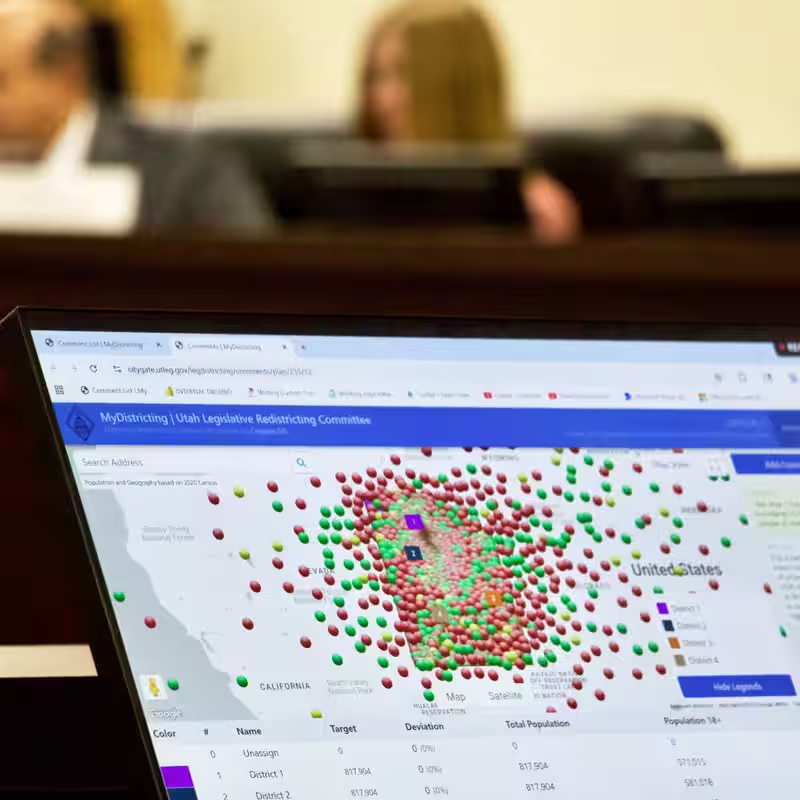
The current proposed map keeps three solidly Republican districts but redraws the 4th District—anchored in Salt Lake City—to better reflect its growing urban, diverse, and moderate electorate. Polling suggests this district could flip blue in a strong Democratic year.
What This Means for 2026 and Beyond
If the fairer map passes, Utah could lose one of its reliably Republican House seats—a rare case of a red state voluntarily reducing its own partisan advantage.
For Democrats, it’s a glimmer of hope in an otherwise bleak redistricting landscape. For reformers, it’s proof that even in polarized times, good governance can win out.
“Utah is showing that you don’t have to choose between party loyalty and democratic integrity,” said Lisa Handley, a redistricting expert at the University of Utah.
A Model for Other States?
Utah’s approach stands in stark contrast to states like Texas and Florida, where Republicans have aggressively gerrymandered to eliminate competitive districts.
Advocates hope Utah’s example could inspire similar reforms elsewhere—especially in states where voters have already approved independent commissions but face resistance from lawmakers.
As one Salt Lake City activist put it: “Fair maps aren’t about helping Democrats or Republicans. They’re about helping democracy.”
Sources
The New York Times: The Redistricting Fight You Haven’t Heard About
Utah State Legislature: Redistricting Commission
Brennan Center for Justice: Redistricting Reform Tracker