Table of Contents
- Life in the Aftermath of Airstrikes
- Surreal Art Meets Harsh Reality
- Economic Strain and Everyday Resilience
- Geopolitical Tensions Escalate
- Sources
Life in the Aftermath of Airstrikes
In the wake of devastating American and Israeli airstrikes in June 2025, Tehran has been gripped by a quiet but pervasive sense of unease. Yet, beneath the surface tension, life continues—albeit with a heavier weight. Residents go about their days, balancing survival with uncertainty, as the city tries to stitch itself back together after a 12-day war that reshaped Iran’s geopolitical standing.
For many, the conflict felt like déjà vu—an echo of past hostilities layered over fresh wounds. But this time, the stakes felt higher. With regional influence waning and internal pressures mounting, ordinary Iranians are caught between resilience and resignation.
Surreal Art Meets Harsh Reality
Nowhere is this tension more visible than in Tehran’s cultural spaces. At the Dayhim Art Society—a repurposed furniture factory turned gallery—an unfinished surrealist exhibition became an unintentional metaphor for the nation’s suspended reality.
A fiberglass elephant, dangling from the rafters of a disused industrial space, was meant to welcome visitors in June. Instead, it hung in silence as missiles lit up the night sky. “We called them ‘the fireworks,’” said gallery owner Houman Dayhimi, his tone laced with bitter irony. “Every night, we’d sit in the courtyard and watch explosions paint the horizon.”
The artists, stranded by the sudden outbreak of war, transformed the gallery into both shelter and witness. What was meant to be a commentary on illusion and perception became a literal reflection of life in wartime Tehran—where art and reality blur into one.
Economic Strain and Everyday Resilience
Dayhimi’s story is emblematic of a broader economic unraveling. A decade ago, his factory employed 700 people. U.S. sanctions forced its closure, pushing him to reinvent the space as a hub for art and tech startups. Now, even that fragile ecosystem teeters on the edge.
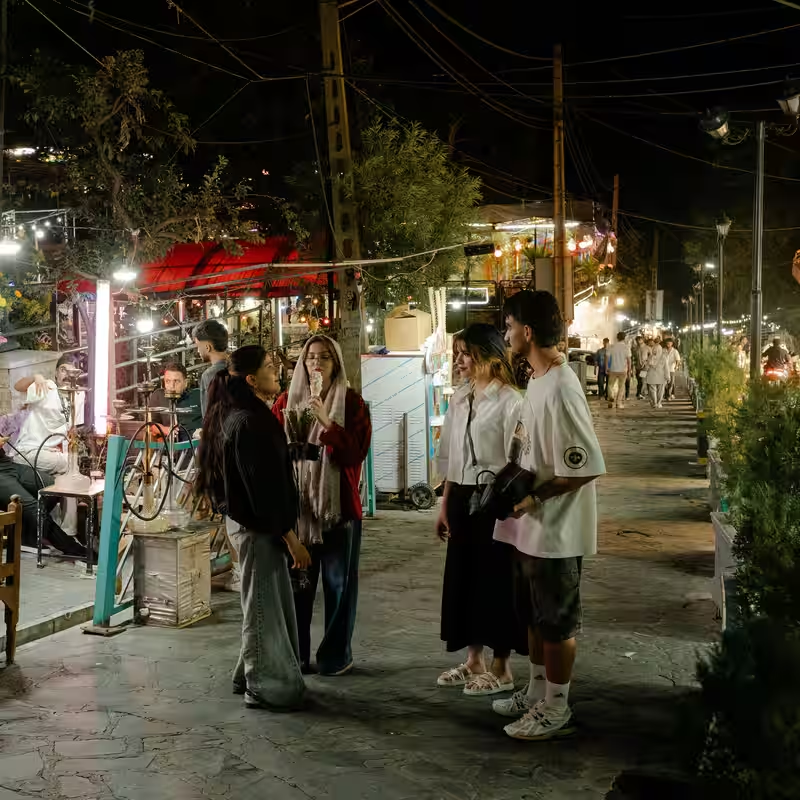
Despite the hardship, Tehranis persist. Street vendors sell burgers under strings of fairy lights. Families gather in parks, speaking in hushed tones about politics but laughing loudly over shared meals. It’s a city learning to breathe again—cautiously, deliberately.
Geopolitical Tensions Escalate
The June airstrikes marked a turning point. What began as targeted Israeli strikes quickly drew in the United States, igniting a brief but intense conflict that exposed Iran’s growing isolation in the region. Analysts suggest this moment may signal the beginning of a more volatile era—one where Tehran’s traditional alliances fray and domestic discontent simmers.
Yet, for the average citizen, geopolitics feels distant compared to the immediacy of inflation, power outages, and the fear of another midnight siren. As one local put it: “We don’t have the luxury of waiting for peace. We have to live today.”
Sources
Spies, Burgers and Bombs: After a New War, Old Wounds Resurface in Tehran – The New York Times