On November 7, 2025, China officially commissioned its most advanced warship to date: the **Fujian**, the People’s Liberation Army Navy’s (PLAN) third aircraft carrier—and its first to feature cutting-edge catapult-assisted launch systems. Named after China’s southeastern coastal province, the **Fujian** marks a strategic leap in Beijing’s naval ambitions and signals a shift toward genuine blue-water power projection in the Indo-Pacific.
Unlike its predecessors—the *Liaoning* and *Shandong*, which rely on ski-jump decks—the **Fujian** is equipped with **three electromagnetic catapults**, enabling it to launch heavier aircraft with greater fuel and weapons loads. This puts China on near-parity with the U.S. Navy in carrier-based aviation technology, a domain long dominated by American supercarriers.
Table of Contents
- Fujian’s Specifications and Capabilities
- The Genius Behind the Electromagnetic Catapult
- Strategic Impact in the Indo-Pacific
- What Comes After Fujian?
- Conclusion
- Sources
Fujian’s Specifications and Capabilities
Constructed at the Jiangnan Shipyard in Shanghai, the **Fujian** displaces approximately **80,000 tons**, making it the largest warship ever built by China. Though conventionally powered (not nuclear), it represents a massive engineering achievement—particularly in its flight deck layout and launch systems.
Key features include:
- Three Electromagnetic Aircraft Launch Systems (EMALS), allowing simultaneous launch of fighters, early-warning aircraft, and drones
- Ability to operate **J-35 fifth-generation stealth fighters**, **KJ-600 airborne early warning planes**, and **Z-20 helicopters
- Modernized aircraft handling and recovery systems comparable to U.S. *Ford*-class carriers
During its commissioning ceremony at Yulin Naval Base—attended by President Xi Jinping—the carrier was showcased with its full air wing displayed on deck, underscoring its operational readiness.
The Genius Behind the Electromagnetic Catapult
The true innovation behind the **Fujian** lies in its electromagnetic launch system—a technological breakthrough spearheaded by **Rear Admiral Ma Weiming**, a professor at the PLA Naval University of Engineering.
Often dubbed the “father of China’s EMALS,” Ma reportedly championed the adoption of electromagnetic catapults over traditional steam systems, despite skepticism within Chinese defense circles. “If we are doing it, we go for the cutting-edge,” Ma declared in a 2017 state TV appearance. “We should never wait until foreigners make it and then follow.”
His two-decade focus on direct-current shipboard power systems enabled the **Fujian** to integrate EMALS without nuclear propulsion—a feat the U.S. Navy achieved only on its nuclear-powered *Ford*-class carriers.
Strategic Impact in the Indo-Pacific
The commissioning of the **Fujian** doesn’t just elevate China’s navy—it reshapes regional military dynamics. With the ability to launch early-warning aircraft like the KJ-600, the carrier can now conduct **long-range surveillance, command coordination, and precision strikes** far beyond China’s coastline.
This comes amid a broader naval arms race in Asia:
- India has deployed its indigenous carrier *Vikrant* and plans to equip it with Rafale-M fighters
- Japan is converting its *Izumo*-class destroyers to support F-35B operations
- South Korea and Indonesia are exploring drone-capable carrier concepts
As noted by USNI News, the **Fujian** positions China to challenge U.S. naval dominance in contested waters like the South China Sea and near Taiwan.
What Comes After Fujian?
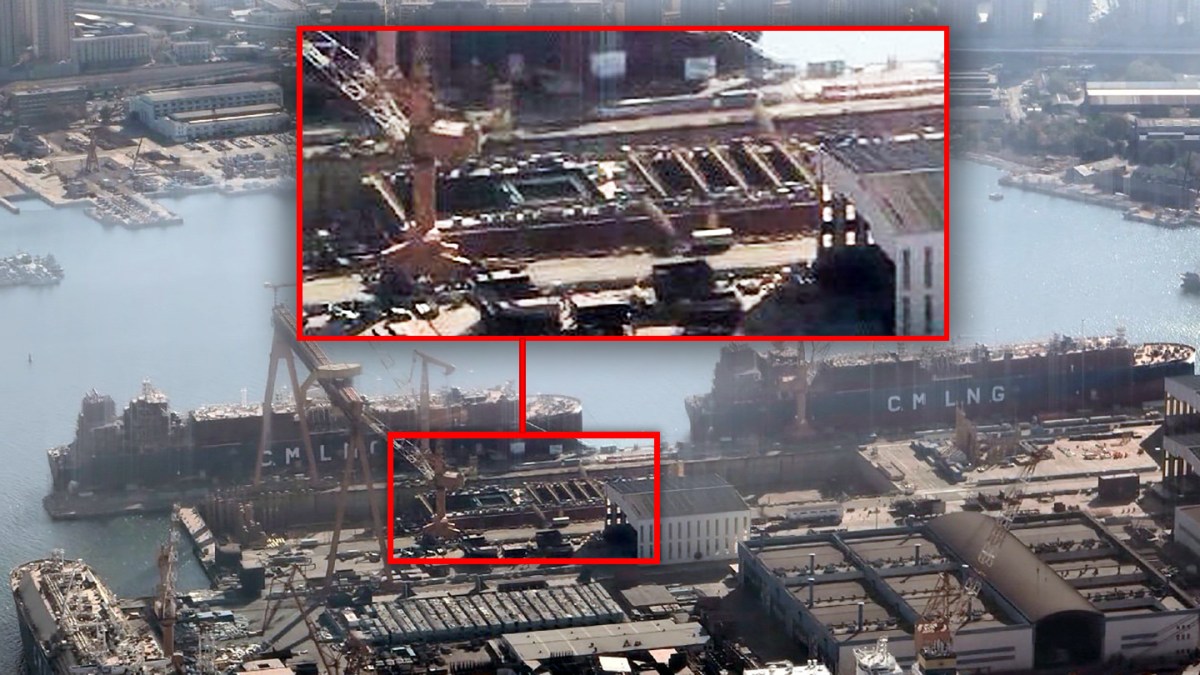
Even as the **Fujian** enters service, satellite imagery and shipyard analysis suggest China is already building its **fourth carrier—and possibly its first nuclear-powered flattop**. According to The War Zone, construction activity at Jiangnan shows signs of a larger, nuclear-propelled hull under development.
If confirmed, this next-generation carrier would offer near-unlimited range and higher sortie rates—bringing China even closer to U.S.-level carrier operations.
Conclusion
The **Fujian** is more than just a warship; it’s a symbol of China’s rapid military modernization and its intent to become a global naval power. While questions remain about its operational efficiency compared to American carriers, its very existence reshapes strategic calculations across the Indo-Pacific. For Beijing, the **Fujian** isn’t the end—it’s the beginning of a new carrier era.