In a dramatic Senate showdown that underscores deepening tensions over presidential war powers, Republicans blocked a Democratic-led resolution aimed at halting President Trump’s controversial military strikes in the Caribbean Sea. The vote—51 to 48 along mostly party lines—leaves the administration free to continue its legally disputed campaign against alleged drug-running vessels linked to Venezuela.
What Are Trump’s Caribbean Strikes?
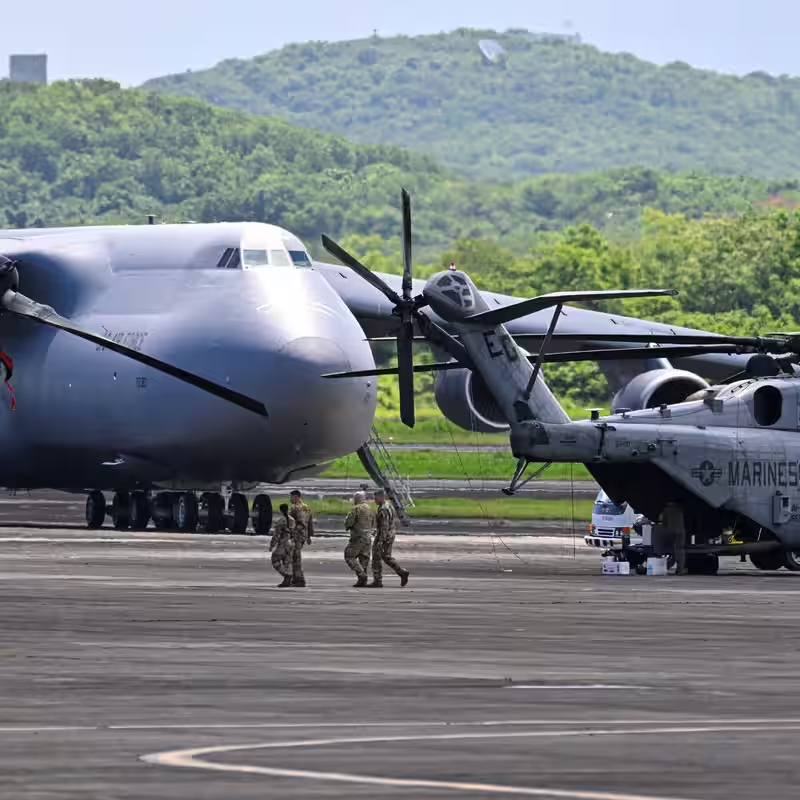
Since September 2, 2025, the Trump administration has launched four military strikes in the Caribbean, claiming they target boats operated by Venezuelan drug cartels smuggling fentanyl into the U.S. According to the White House, these operations have killed 21 people. But critics—including members of both parties—question the legal basis, intelligence backing, and transparency of these attacks.
President Trump has framed the campaign as a national security imperative, declaring that drug cartels now constitute “terrorist organizations” waging war on American soil. This justification, however, has not been formally vetted by Congress—and that’s exactly what Democrats sought to address.
War Powers Act Invoked—But Overruled
Senators Adam Schiff (D-CA) and Tim Kaine (D-VA) invoked the 1973 War Powers Resolution, a rarely used tool that forces expedited consideration of measures to end unauthorized military actions. Their resolution would have terminated the use of force against vessels in the Caribbean unless Congress explicitly approved it.
“This is the kind of thing that leads the country unexpectedly and unintentionally into war,” Schiff warned, pointing to the administration’s recent decision to abandon diplomatic talks with Venezuela as a sign of potential escalation.
Republican Unity—With Two Notable Defections
Despite bipartisan concerns, only two Republicans broke ranks: Senators Rand Paul (KY) and Lisa Murkowski (AK). Both have long questioned expansive executive military power.
“If anyone gave a you-know-what about justice, perhaps those in charge of deciding whom to kill might let us know their names,” Paul said sharply, criticizing the lack of public evidence linking the targeted boats to actual drug trafficking.
Murkowski added: “We all want to get rid of the drugs in this country… But the approach that the administration is taking is new, some would say novel, and I think we have a role here.”
Inside the Legal Controversy
The Trump administration claims its actions fall under Article II of the Constitution, which designates the president as commander-in-chief. It argues that fentanyl smuggling poses an “imminent threat” to national security—thus justifying lethal force without congressional approval.
But legal scholars and lawmakers counter that drug interdiction has traditionally been a law enforcement matter, not an act of war. Past presidents have used military assets for surveillance or support—but not for targeted killings at sea without clear attribution.
Table: Key Facts About the Caribbean Strikes
| Detail | Information |
|---|---|
| First Strike Date | September 2, 2025 |
| Number of Strikes | 4 (as of October 8, 2025) |
| Reported Fatalities | 21 killed |
| Target | Alleged Venezuelan drug cartels |
| Congressional Authorization | None granted |
| Senate Vote on Limiting Strikes | 51–48 against (Oct 8, 2025) |
What’s Next? A Broader Authorization Looms
Ironically, while Democrats tried to rein in the president, some Republicans are now pushing to do the opposite: grant Trump formal authority to expand strikes not just against boats, but potentially against Venezuela itself.
Senator James Risch (R-ID), chair of the Foreign Relations Committee, defended the campaign: “This is an attack on the United States by people who have been designated as terrorists. The president not only has the right, he has the duty to do something about this.”
Behind closed doors, GOP leaders are reportedly drafting a broad Authorization for Use of Military Force (AUMF) against any group or nation Trump labels a “narco-terrorist”—a move that could dramatically widen U.S. military engagement in Latin America.
A Pattern of Unchecked Power?
This isn’t the first time Trump has bypassed Congress on military action. In June 2025, the Senate similarly rejected a measure to require approval before striking Iran—a campaign that included “Operation Midnight Hammer,” which targeted Iranian nuclear sites.
Senator Kaine noted that repeated unanswered requests for intelligence details—such as proof the boats carried drugs or why interdiction wasn’t attempted—show a troubling lack of accountability.
“These are really important questions,” he said. “We asked for a response within a week. We’ve not gotten answers.”
As the 2026 midterms approach, the clash over war powers may become a defining issue—not just for foreign policy, but for the balance of power in American democracy itself.