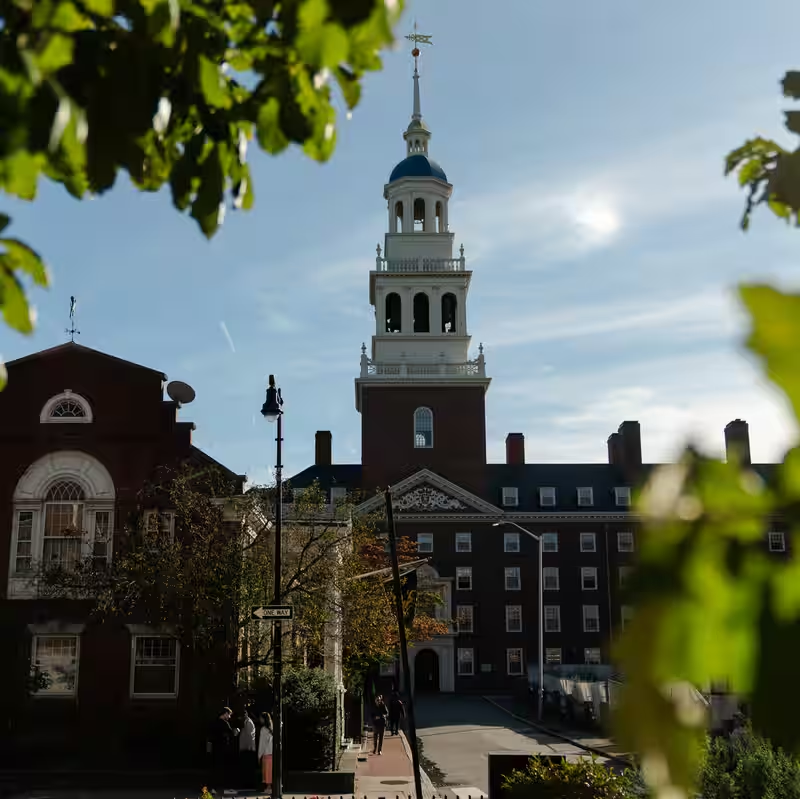
Harvard University is back at the negotiating table with the Trump administration—but this time, it’s demanding ironclad assurances that any deal won’t be followed by a second wave of political demands. As talks resume in Washington, university leaders are deeply skeptical of a new proposal from the White House that could reshape the future of American higher education .
Why Harvard Is Hesitant to Seal the Deal
Last week, President Trump claimed Harvard and the federal government were “very close” to an agreement that would restore billions in critical research funding. But within 24 hours, his administration sent letters to nine elite universities—including Brown, Penn, and the University of Virginia—outlining a sweeping new framework called the “Compact for Academic Excellence in Higher Education.”
The compact asks institutions to adopt politically charged policies on gender definitions, student conduct, and admissions transparency—effectively tying federal research dollars to ideological compliance. For Harvard, this sudden expansion of demands raised a red flag: Will the goalposts keep moving?
“There Are Some People You Don’t Want to Write a Contract With”
Nobel laureate and Harvard economics professor Oliver Hart put it bluntly in a July interview: “There are some people you don’t want to write a contract with, and I think businesses know that very well” .
Faculty and students share that concern. Many fear that even if Harvard signs a deal today, the administration could return months later with new conditions—especially given recent precedents. At the University of Virginia, for example, President James E. Ryan was forced to resign under White House pressure before negotiations could proceed .
The Compact: Policy Shift or Power Play?
The proposed compact includes vague but far-reaching language about “academic excellence,” “free expression,” and “government oversight.” But education leaders see through the rhetoric.
“There isn’t internal coherence to it, except for one thing,” said Ted Mitchell, president of the American Council on Education. “‘We want institutions to do exactly what we want at any point in time.’ Today it’s these things. Next week, it may be a whole new set. This is a power play” .
So far, no university has signed onto the compact. The University of Texas system has expressed interest, but even they remain noncommittal as the October 20 response deadline approaches.
Stephen Schwarzman Steps In—But Can He Deliver?
Adding a dramatic twist, Harvard has tapped billionaire financier and Trump ally Stephen A. Schwarzman as its lead negotiator—a rare move that bypasses traditional academic diplomacy. Schwarzman, founder of Blackstone and a major donor to both Harvard and Republican causes, brings direct access to the president but also raises questions about institutional independence.
Still, Harvard’s leadership sees his involvement as necessary to cut through bureaucratic gridlock. The alternative—losing access to over $1 billion in annual federal research grants—is simply untenable.
What’s at Stake for American Higher Education?
This isn’t just about Harvard. The outcome of these talks could set a precedent for how the federal government interacts with private universities nationwide. If the compact becomes a template, it may force institutions to choose between funding and academic freedom.
Already, Brown University pledged $50 million to workforce programs to secure its deal, while Penn agreed to unspecified policy changes . But Harvard, as the nation’s oldest and most prestigious university, is seen as the ultimate test case.
As one insider put it: “If Harvard caves, everyone caves.”