Table of Contents
- Two Years After Oct. 7: A Country Consumed by Doubt
- The Human Cost in Gaza—and Israel’s Global Standing
- Israel’s Deepening Internal Rifts
- The Unhealed Wound: Hostages Still Missing
- Trump’s Controversial Gaza Proposal Sparks Backlash
- Sources
Two Years After Oct. 7: A Country Consumed by Doubt
On the second anniversary of the Hamas attacks of October 7, 2023, Israel finds itself not only at war with Hamas—but deeply at war with itself. What began as a unified national response to an unprecedented assault has fractured into a landscape of grief, anger, and ideological division.
“I found a country consumed by doubt,” wrote Roger Cohen, The New York Times correspondent, after a recent visit to Israel. That doubt isn’t just about military strategy—it’s about identity, morality, and the very future of the Jewish state.
The Human Cost in Gaza—and Israel’s Global Standing
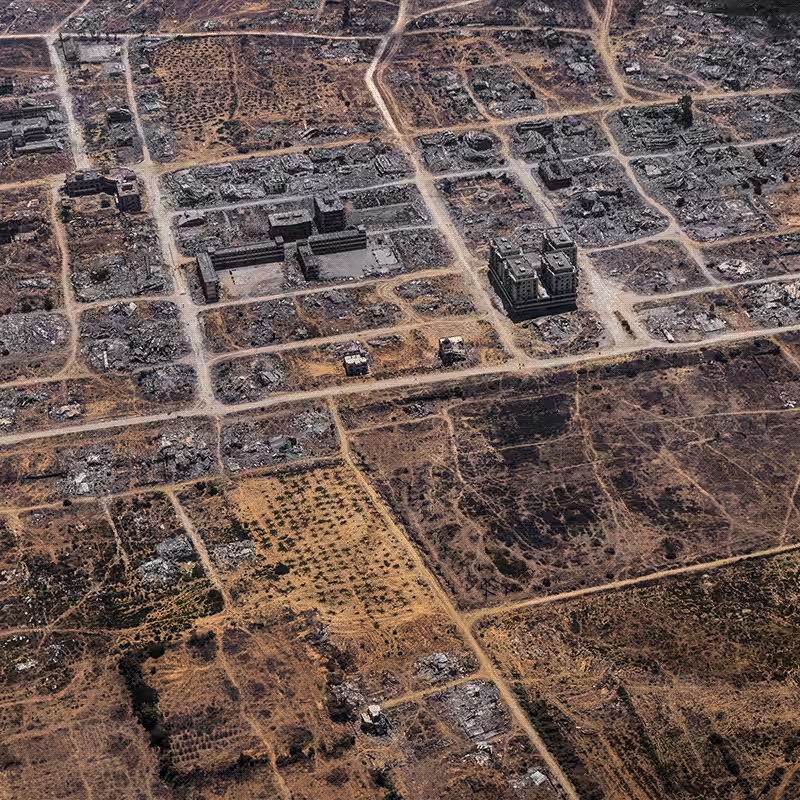
The war in Gaza has claimed more than 67,000 Palestinian lives, according to local health officials—a toll that has drawn condemnation from much of the international community. Entire neighborhoods lie in rubble. Hospitals, schools, and bakeries have been reduced to dust.
As destruction mounts, so does global isolation. Accusations of genocide, though legally contested, have gained traction in international courts and public discourse. Antisemitism has surged worldwide, while support for Palestinian statehood has grown—even among traditional Israeli allies.
For many Israelis, this isolation feels like betrayal. For others, it’s a mirror forcing a reckoning.
Israel’s Deepening Internal Rifts
Inside Israel, the war has exposed and widened fault lines that predate October 7:
- Secular vs. religious Zionists: Tensions flare over mandatory military service for ultra-Orthodox Jews.
- Settlers vs. centrists: The expansion of West Bank settlements continues, undermining any near-term path to a two-state solution.
- Families of hostages vs. government: Many accuse Prime Minister Benjamin Netanyahu of prioritizing political survival over hostage rescue deals.
“Israel is at war with Hamas,” Cohen observes. “But it is also at war with itself.”
The Unhealed Wound: Hostages Still Missing
Despite multiple cease-fire attempts and prisoner exchanges, over 100 hostages remain unaccounted for—some believed dead, others possibly still alive in Gaza’s tunnels. Their absence haunts public consciousness.
Weekly vigils in Tel Aviv draw thousands. Yellow ribbons flutter from car antennas. Billboards plead: “Bring Them Home.” Yet negotiations stall amid mutual distrust between Israel, Hamas, and mediators like Qatar and Egypt.
For families, every passing day deepens the trauma. “We’re not asking for peace,” said one mother at a recent rally. “We’re asking for our children.”
Trump’s Controversial Gaza Proposal Sparks Backlash
Adding to the complexity, former U.S. President Donald Trump recently floated a plan to transform Gaza into a “coastal business emporium”—run by international investors, with minimal Palestinian governance.
The proposal, which envisions “preferred tariff rates” and luxury developments along the Mediterranean, has been widely criticized as tone-deaf and colonial. Palestinians call it an erasure of their right to self-determination. Even some Israeli economists question its feasibility.
“Prosperity cannot be imposed on a people whose dignity has been shattered,” said Dr. Lea Hadad, a political scientist at Tel Aviv University.