Table of Contents
- A Leader at a Pivotal Moment
- What Oaks Said About the Michigan Attack
- The Significance of Dallin H. Oaks
- Faith Under Fire
- What Comes Next for the Latter-day Saints
- Sources
A Leader at a Pivotal Moment
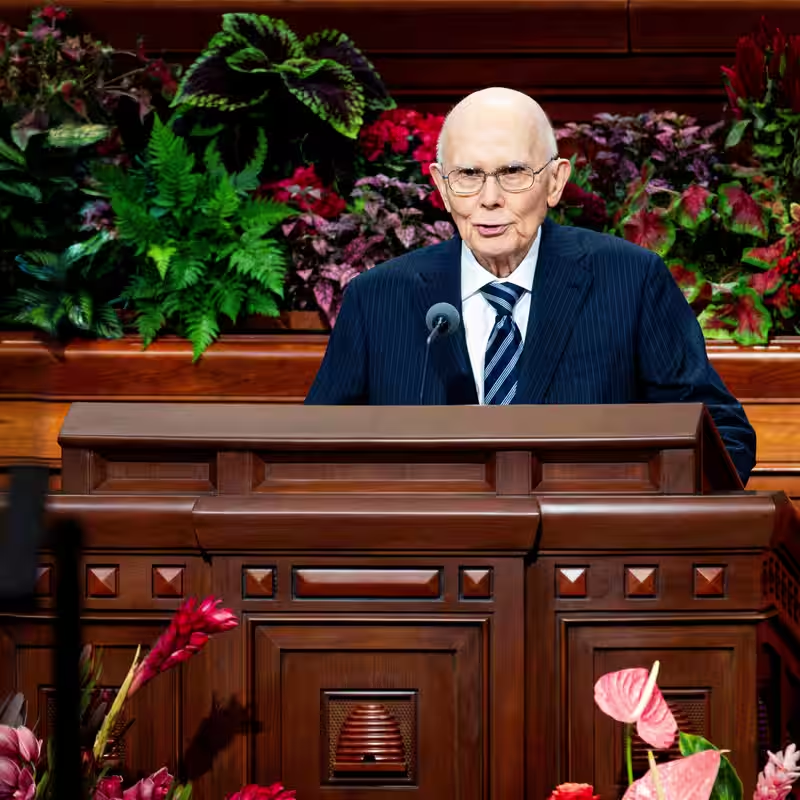
At 93 years old, Dallin H. Oaks stood before tens of thousands of Latter-day Saints during the October 2025 General Conference—not just as a senior apostle, but as the designated next president of The Church of Jesus Christ of Latter-day Saints. His address came just one week after a violent attack on a church meetinghouse in Grand Rapids, Michigan, that left congregants shaken and the national community on edge.
In a calm, steady voice that belied his age, Oaks delivered a message centered on resilience, unity, and unwavering faith. “Evil may knock at our door,” he said, “but it cannot enter unless we invite it in through fear or hatred.”
What Oaks Said About the Michigan Attack
Oaks did not dwell on the details of the October 1 incident—in which a lone assailant damaged property and hurled anti-Mormon slurs before being subdued by local members—but he acknowledged the pain it caused.
“We do not retaliate,” he emphasized. “We respond with love, with service, and with a commitment to build bridges, not walls.” His words were met with sustained applause from the Salt Lake City Conference Center and echoed in chapels across 190 countries where members watched the broadcast.
He also urged members to report threats, cooperate with law enforcement, and continue gathering in worship—“for it is in community that we find strength.”
Latter-day Saints Look to Oaks as Successor
As the longest-serving apostle in the current Quorum of the Twelve, Dallin H. Oaks is next in line to become the 18th president of the global church, following the passing of current President Russell M. Nelson, who is 101. Oaks’ leadership is expected to mark a transitional era—balancing doctrinal orthodoxy with increasing engagement on social issues like mental health, religious freedom, and interfaith dialogue.
Born in 1932, Oaks is a former Utah Supreme Court justice and law professor. His legal mind and measured tone have long made him a respected voice within the church—and increasingly, in American public life.
Key Themes from Oaks’ Conference Talk
- Peace over retaliation: Rejecting vengeance in the face of hostility
- Unity in diversity: Encouraging respect across political and cultural lines
- Vigilance without fear: Staying alert but not paralyzed by threats
- Service as witness: Letting actions—not just words—define faith
Faith Under Fire
The Michigan attack was not the first time Latter-day Saints have faced hostility, but it struck a chord in an era of rising religious intolerance. Church leaders have noted a 22% increase in reported incidents of harassment or vandalism against meetinghouses since 2020, according to internal data shared with local leaders.
Yet Oaks’ message was not one of victimhood, but of resolve. “Our mission is not to defend ourselves,” he said, “but to bless the lives of others—even those who misunderstand us.”
This stance resonated deeply with members like Maria Lopez, a convert from Arizona: “He didn’t sound angry. He sounded like a grandfather who’s seen hard times but still believes in goodness.”
What Comes Next for the Latter-day Saints
With Oaks poised to assume the presidency, observers expect continuity in core doctrine but subtle shifts in tone—more emphasis on compassion, clearer communication on complex issues, and stronger partnerships with other faith communities.
His conference talk may well be remembered as a defining moment: not just a response to violence, but a blueprint for how a global religious community can navigate fear with grace.
As one attendee put it: “At 93, he’s teaching us how to be brave—not with fists, but with faith.”