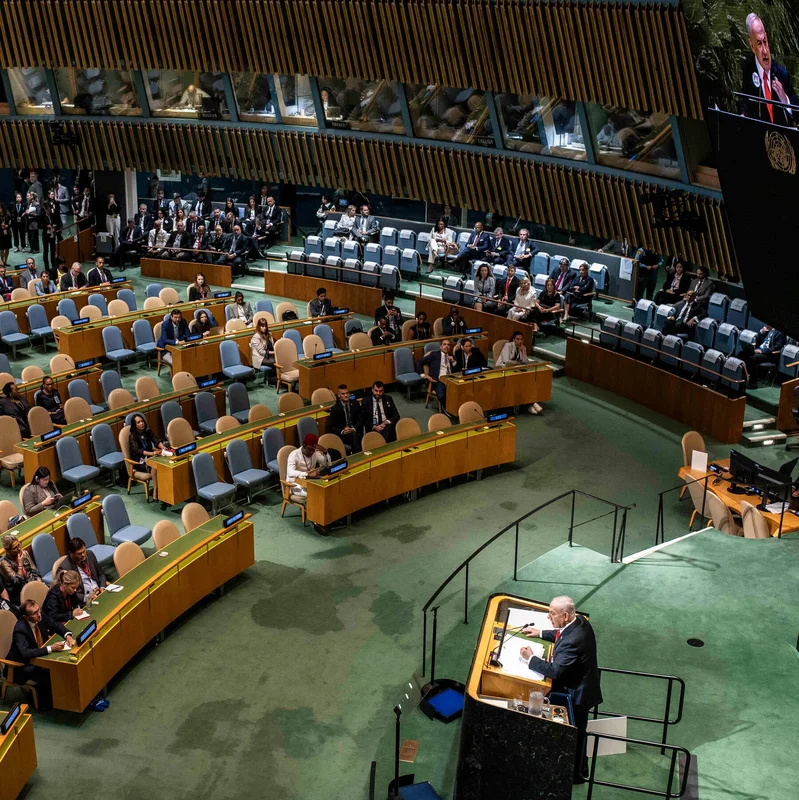
In a dramatic display of diplomatic isolation, Israeli Prime Minister Benjamin Netanyahu delivered a defiant speech at the United Nations General Assembly on September 26, 2025—only to find much of the hall nearly empty. As he declared that a Palestinian state would amount to “national suicide” for Israel, dozens of world leaders and diplomats staged a quiet but unmistakable boycott, underscoring growing global frustration with Israel’s policies in Gaza and the occupied territories .
A Speech to an Empty Hall
Traditionally, U.N. General Assembly speeches draw packed audiences, especially from major powers. But Netanyahu’s appearance was markedly different:
- Over 40 countries did not send representatives to the chamber during his address
- European Union delegations largely remained absent, including Germany, France, and Spain
- U.S. officials attended but sat silently, offering no public endorsement
- Arab and Global South nations walked out or skipped the session entirely
🌍 Diplomatic Signal: The boycott reflects a broader shift—138 of 193 U.N. member states now recognize Palestine as a state, including recent recognitions by Spain, Ireland, and Norway in 2024.
Netanyahu’s Core Arguments—and Global Rebuttals
Netanyahu’s speech centered on three main claims:
- “A Palestinian state equals an Iranian missile base” — He argued Hamas and Iran would exploit sovereignty to threaten Israel.
- “Security control must remain Israeli forever” — He rejected any transfer of military authority in the West Bank.
- “Recognition rewards terrorism” — He tied Palestinian statehood to the October 7, 2023, Hamas attacks.
However, many world leaders countered that Israel’s ongoing occupation and settlement expansion are themselves violations of international law.
Who Boycotted—and Why
| Country/Region | Reason for Absence | Recent Policy Shift |
|---|---|---|
| Spain | Recognized Palestine in May 2024 | Now advocates for two-state solution at U.N. |
| South Africa | Ongoing ICJ genocide case against Israel | Called Netanyahu’s speech “defiant of justice” |
| Canada | Protesting civilian deaths in Rafah | Suspended some arms exports to Israel |
| African Union | Solidarity with Palestinian statehood bid | Backed Palestine’s U.N. Security Council application |
The U.S. Position: Support With Quiet Reservations
While the Biden administration continues to shield Israel at the U.N. Security Council, its tone has grown more cautious:
- Vice President Kamala Harris did not attend Netanyahu’s speech
- State Department officials called his “national suicide” remark “unhelpful”
- The U.S. abstained on a recent U.N. resolution calling for Palestinian statehood—a break from past vetoes
What Comes Next for Palestine at the U.N.?
Palestinian leaders are pushing for full U.N. membership—a move requiring Security Council approval, where the U.S. holds veto power. But momentum is building:
📊 Flowchart: Path to Palestinian U.N. Membership
- Palestine submits membership application
- Security Council reviews (requires 9 of 15 votes)
- If approved, General Assembly votes (requires 2/3 majority)
- If vetoed, Palestine seeks upgraded observer status or symbolic recognition
- Global pressure mounts on U.S. and Israel
For deeper context on the legal status of Palestine, see our explainer: [INTERNAL_LINK:palestine-un-membership-explained].
For official U.N. positions and voting records, visit the U.N. Information System on the Question of Palestine.
Sources
- https://www.nytimes.com/2025/09/26/world/middleeast/netanyahu-speech-united-nations.html
- https://www.un.org/unispal/
- https://www.icj-cij.org/case/192
- https://www.brookings.edu/articles/global-recognition-of-palestine-2025-update/