Sébastien Lecornu Resigns Just Hours After Becoming France’s Prime Minister
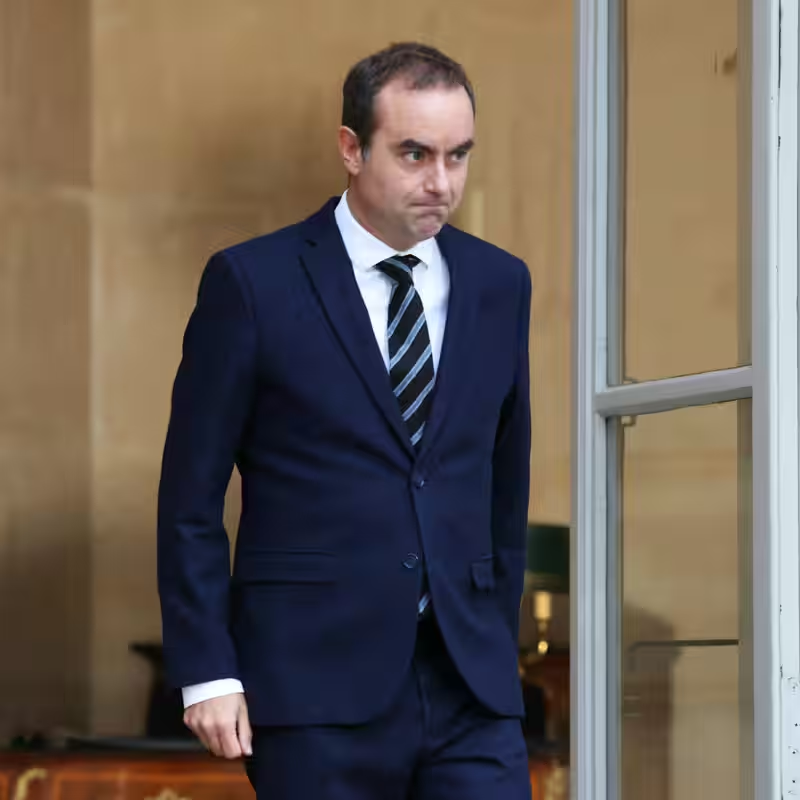
In a stunning political reversal, Sébastien Lecornu has resigned as Prime Minister of France less than 24 hours after unveiling his new cabinet. The abrupt departure—confirmed by the Élysée Palace on October 6, 2025—has thrown President Emmanuel Macron’s government into chaos and raised urgent questions about the stability of France’s executive leadership .
Table of Contents
- What Happened? A Timeline of Lecornu’s 24-Hour Premiership
- Why Did Lecornu Step Down?
- Macron’s Crisis: Leadership Vacuum at a Critical Time
- Political Fallout Across the French Spectrum
- How This Compares to Past French Political Crises
- Sources
What Happened? A Timeline of Lecornu’s 24-Hour Premiership
Appointed by President Emmanuel Macron on October 5, 2025, Sébastien Lecornu—a former defense minister known for his centrist pragmatism—was tasked with forming a government amid deep parliamentary fragmentation following the June 2025 legislative elections.
By evening, Lecornu announced a 22-member cabinet blending technocrats, Macron loyalists, and moderate figures from the left and right. But by the next morning, he submitted his resignation without a formal explanation.
According to sources close to the Élysée, Lecornu realized overnight that he lacked sufficient support in the National Assembly to pass even basic confidence motions—let alone advance Macron’s agenda on pension reform, immigration, and EU fiscal policy.
Why Did Lecornu Step Down?
While no official reason was given, political analysts point to three key factors:
- No Parliamentary Majority: Macron’s Renaissance party holds only 168 of 577 seats—far short of a majority.
- Opposition Unity: The left-wing New Popular Front and far-right National Rally both signaled they would block any Lecornu-led government.
- Internal Party Doubts: Even within Macron’s camp, some ministers reportedly questioned Lecornu’s ability to command authority after a bruising defense portfolio tenure.
“He didn’t resign out of weakness,” said political scientist Claire Durand. “He resigned because he understood the math—and refusing to lead a doomed government is, in fact, an act of responsibility.”
Macron’s Crisis: Leadership Vacuum at a Critical Time
President Macron now faces one of the most precarious moments of his presidency. With France hosting the EU Council presidency in early 2026 and preparing for municipal elections next spring, the absence of a functioning government could paralyze domestic policy and weaken France’s voice in Brussels.
The Élysée has announced that Macron will consult party leaders this week before naming a new prime ministerial candidate—possibly from outside his own coalition in a bid for broader consensus.
Political Fallout Across the French Spectrum
Reactions poured in swiftly:
- Marine Le Pen (National Rally): “This proves Macron’s project is bankrupt. France needs new leadership—now.”
- Jean-Luc Mélenchon (LFI): “A 24-hour government? That’s not governance—it’s theater.”
- Laurent Wauquiez (Les Républicains): Called for “a government of national unity” to avoid further instability.
How This Compares to Past French Political Crises
France’s Fifth Republic has seen short-lived governments before—but rarely this brief. The previous record for shortest premiership belonged to Maurice Couve de Murville in 1968, who served just 44 days.
Lecornu’s 24-hour tenure may now stand as a symbol of the deep institutional gridlock triggered by France’s 2025 “tripolar” parliament—where no bloc holds decisive power.
Recent French Prime Ministers and Tenures (2020–2025)
| Name | Party | Tenure | Reason for Departure |
|---|---|---|---|
| Jean Castex | Renaissance | 2020–2022 | Post-election reshuffle |
| Élisabeth Borne | Renaissance | 2022–2024 | No-confidence motion |
| Gabriel Attal | Renaissance | 2024–2025 | Resigned after election loss |
| Sébastien Lecornu | Renaissance | Oct 5–6, 2025 | Resigned before confidence vote |