The future of American democracy may hinge on a single Supreme Court decision. In a high-stakes case reargued this month, the justices are weighing whether the Voting Rights Act—a cornerstone of civil rights legislation since 1965—can survive in its current form. At the heart of the dispute is a simple but explosive question: Can lawmakers consider race when drawing congressional district lines? The answer could determine the fate of minority representation across the United States and flip key congressional seats from blue to red overnight .
What’s at Stake in Louisiana v. Callais?
The case, Louisiana v. Callais, began after the 2020 census revealed that Black adults made up roughly one-third of Louisiana’s population—yet only one of the state’s six congressional districts was majority-Black. Civil rights groups sued, arguing this diluted Black voting power in violation of Section 2 of the Voting Rights Act.
In response, Louisiana lawmakers drew a second majority-Black district in early 2024—a long, serpentine stretch from the southeast to the northwest. The move led to the election of Cleo Fields, a Black Democrat, in the 2024 cycle. But soon after, a group of white voters challenged the map as an unconstitutional racial gerrymander.
A federal panel struck down the map in April 2024. The Supreme Court paused that ruling to allow the map’s use in the election—but then did something unusual: it ordered reargument for its new term, signaling it may be preparing a sweeping decision .
Voting Rights Act: From Civil Rights Triumph to Constitutional Target
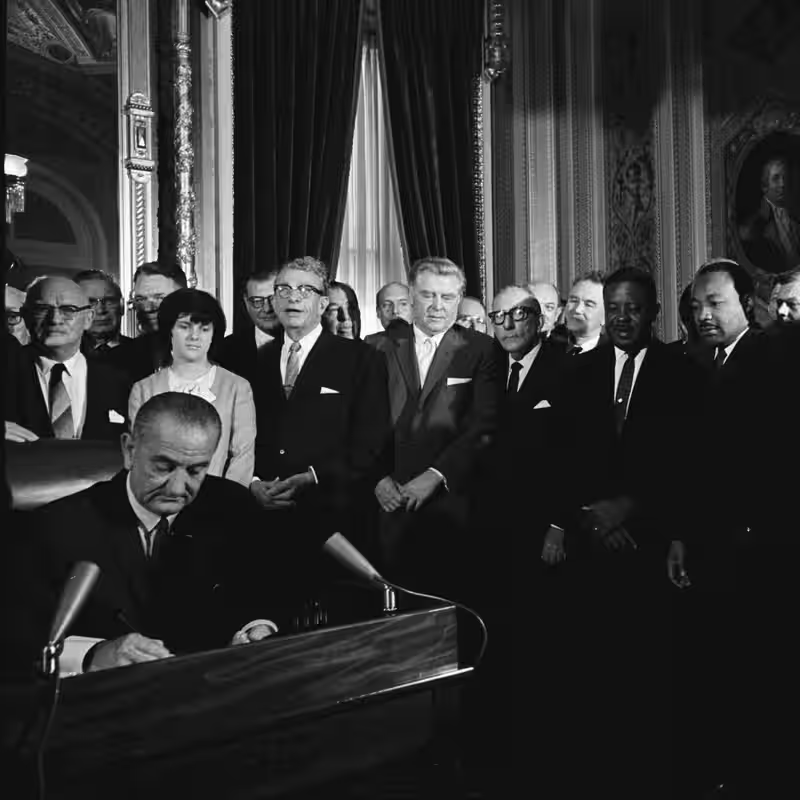
Passed in 1965, the Voting Rights Act outlawed literacy tests, poll taxes, and other tools used to disenfranchise Black voters. Section 2—the provision now under fire—prohibits any voting practice that results in minority voters having “less opportunity than other members of the electorate to participate in the political process.”
For decades, courts have interpreted this to mean states must create majority-minority districts where feasible. But conservative justices have long questioned whether using race in redistricting violates the 14th Amendment’s Equal Protection Clause, which demands “colorblind” treatment under the law.
Key Provisions of the Voting Rights Act Under Threat
| Provision | Purpose | Current Legal Status |
|---|---|---|
| Section 2 | Prohibits voting practices that discriminate based on race | Active—but now challenged in Louisiana v. Callais |
| Section 5 (preclearance) | Required certain states to get federal approval before changing voting laws | Struck down by SCOTUS in Shelby County v. Holder (2013) |
| Section 4(b) | Defined which jurisdictions needed preclearance | Also invalidated in 2013 ruling |
Strange Alliances and Shifting Positions
In a dramatic twist, Louisiana’s own officials—who originally defended the second majority-Black district—have now switched sides. Joined by the Trump administration, Louisiana Attorney General Liz Murrill now argues that Section 2 is “unworkable and unconstitutional,” claiming it relies on “racial stereotypes” that assume all Black voters think alike .
On the other side, the NAACP Legal Defense Fund, ACLU, and other civil rights organizations are defending the map, warning that striking down Section 2 would roll back 60 years of progress and return the U.S. to an era of systemic disenfranchisement.
Nationwide Impact: More Than Just Louisiana
If the Court rules that race cannot be a factor in redistricting, the ripple effects would be immediate and massive. States like Georgia, North Carolina, Texas, and Alabama—where majority-minority districts have enabled Black and Latino candidates to win federal office—could be forced to redraw maps that dilute minority voting strength.
Analysts estimate that up to 10–15 congressional seats currently held by Democrats could flip to Republican control, not because of voter preference, but because of how district lines are drawn.
What Happens Next?
A decision is expected by June 2026. Given the Court’s recent history—including its 2023 ruling in an Alabama redistricting case that upheld Section 2—the outcome remains uncertain. But the fact that the justices called for reargument suggests they’re considering a radical shift.
As one voting rights advocate put it: “This isn’t just about lines on a map. It’s about whether every American’s voice counts equally.”