Table of Contents
- The SNAP Crisis: What Happened?
- The Court’s Emergency Order
- Who’s Affected by the Payment Delay?
- State Leaders Step In
- What Happens Next?
- Sources
The SNAP Crisis: What Happened?
In a move that left millions of Americans in limbo, the Trump administration announced plans to suspend November 2025 Supplemental Nutrition Assistance Program (SNAP) benefits—commonly known as food stamps—as part of an ongoing federal funding impasse. The decision, tied to a government shutdown, threatened to cut off a vital lifeline for over 40 million low-income individuals and families just as the holiday season approaches .
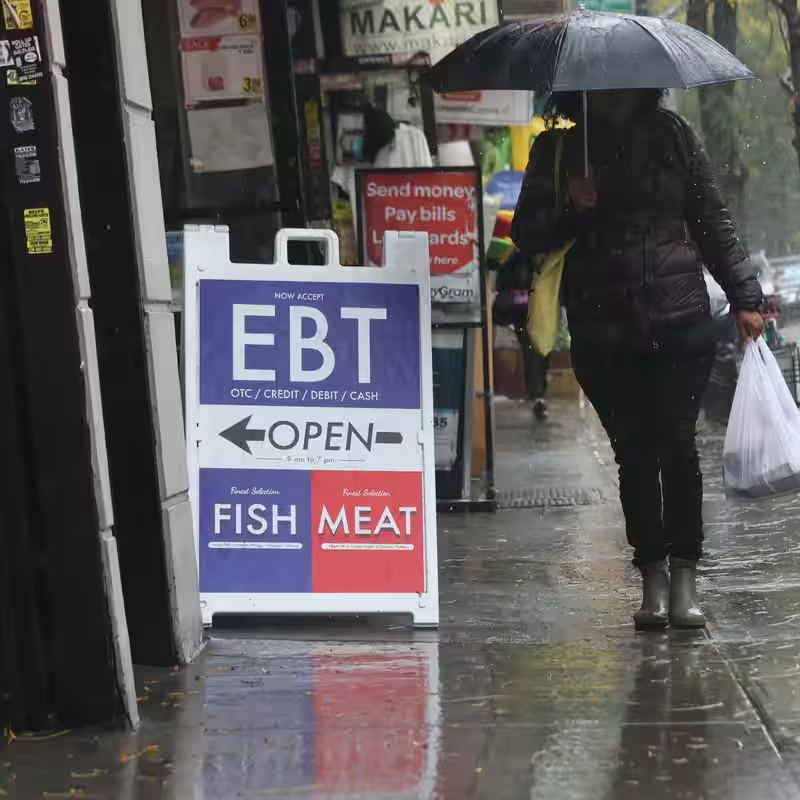
SNAP is the nation’s largest anti-hunger program, providing monthly benefits via EBT cards to purchase groceries. For many recipients, these funds are the difference between a full fridge and an empty one.
The Court’s Emergency Order
But a federal judge has now slammed the brakes on the administration’s plan. On October 31, 2025, U.S. District Judge Indira Talwani issued a preliminary ruling declaring the suspension of SNAP benefits “likely unlawful” and ordered the Trump administration to act immediately .
The written order, finalized on November 1, gives the U.S. Department of Agriculture (USDA) until November 2 to decide whether to release at least partial November benefits—and to publicly announce its plan without delay . The court found that halting SNAP payments during a shutdown violates federal statutes that require uninterrupted nutrition assistance .
Why This Matters for SNAP Recipients
This isn’t just bureaucratic red tape—it’s about survival. Many SNAP households receive their full monthly allocation in the first week of the month. A delay or cancellation could mean skipped meals, increased reliance on food banks, and heightened food insecurity during a critical time of year.
Who’s Affected by the Payment Delay?
The potential disruption impacts a wide swath of the American population:
| Group | Estimated Number Affected | Vulnerability Level |
|---|---|---|
| Children | 18 million | High |
| Seniors (60+) | 5.3 million | High |
| Working Families | 12 million | Medium |
| People with Disabilities | 4.1 million | High |
States like California, Texas, and New York—which have the highest SNAP enrollment—face the greatest logistical and humanitarian challenges if benefits are delayed .
State Leaders Step In
Even before the court ruling, several state attorneys general took action. New York’s Letitia James and New Jersey’s Matthew Platkin filed lawsuits against the federal government, arguing the SNAP suspension was “arbitrary and capricious” and endangered public health [[3], [4]].
Illinois Governor J.B. Pritzker went further, issuing an executive order on October 16 to activate emergency food reserves and coordinate with local nonprofits to fill potential gaps .
What Happens Next?
With the November 2 deadline looming, all eyes are on the USDA. If the agency fails to comply, the court could impose stricter mandates or hold officials in contempt. Meanwhile, advocacy groups like Feeding America and the Center on Budget and Policy Priorities are urging Congress to pass emergency appropriations to shield SNAP from future shutdowns.
For now, SNAP recipients are advised to monitor official state agency websites and local news for updates on their November benefits.
Sources
- The New York Times: Trump Administration Must Make Food Stamp Payments Within Days, Judge Says
- Illinois Governor’s Office Executive Order, October 16, 2025
- U.S. District Court Order, October 31, 2025 [[4], [6]]
- New Jersey Attorney General Press Release, October 28, 2025
- Feeding America & CBPP SNAP Impact Reports, November 2025