Table of Contents
- What Is the Insurrection Act?
- Trump’s Recent Comments
- Why Courts Blocked the Deployment
- Democratic Pushback
- Historical Use of the Act
- What Happens Next?
- Sources
What Is the Insurrection Act?
The Insurrection Act is a 218-year-old federal law that grants the U.S. president extraordinary authority to deploy active-duty military forces domestically under specific emergency conditions. Originally enacted in 1807, it allows the commander-in-chief to bypass state objections and send troops onto American soil to suppress rebellion, domestic violence, or insurrection.
While rarely invoked, the law has been used in pivotal moments—from enforcing desegregation in the 1950s to restoring order after the 1992 Los Angeles riots.
Trump’s Recent Comments
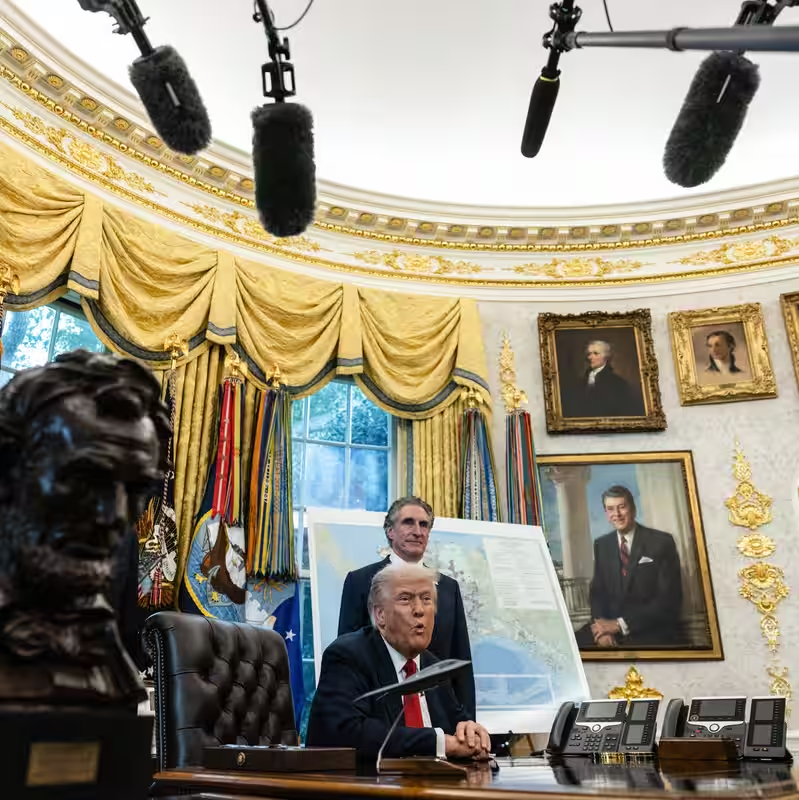
On Monday, October 6, 2025, President Donald Trump signaled he might invoke the Insurrection Act to override court rulings blocking his plan to deploy National Guard troops to major U.S. cities, including Portland, Oregon.
Speaking on the right-wing network Newsmax, Trump said the law could serve as “a way to get around” judicial and local opposition. He added: “If we don’t have to use it, I wouldn’t use it.” But in the Oval Office earlier that day, he outlined specific triggers: “If people were being killed, and courts were holding us up, or mayors or governors were holding us up.”
Trump went further, describing Portland as “on fire for years,” and claimed, “I think that’s all insurrection, really criminal insurrection.”
Why Courts Blocked the Deployment
Federal Judge Karin Immergut—a Trump appointee—issued a restraining order over the weekend halting the deployment of out-of-state National Guard units to Oregon. When the administration attempted to circumvent the ruling, Judge Immergut expanded her order and accused the White House of acting “in direct contravention” of her directive.
The legal core of the dispute centers on whether the president can unilaterally mobilize National Guard troops across state lines without consent from governors—a power traditionally reserved for states under the U.S. Constitution.
Democratic Pushback
Democratic leaders have sharply criticized Trump’s stance. Illinois Governor JB Pritzker accused the president of manufacturing chaos to create a “pretext for invoking the Insurrection Act so that he can send the military to our city.”
Other mayors and governors argue that federal troop deployments undermine local law enforcement and escalate tensions rather than restore order.
Historical Use of the Insurrection Act
| Year | President | Reason for Invocation |
|---|---|---|
| 1957 | Dwight D. Eisenhower | Enforced school desegregation in Little Rock, Arkansas |
| 1962 | John F. Kennedy | Protected James Meredith’s enrollment at University of Mississippi |
| 1992 | George H.W. Bush | Deployed troops during LA riots following Rodney King verdict |
| 2020 | Donald Trump | Considered but did not formally invoke during George Floyd protests |
What Happens Next?
While Trump has not yet formally invoked the Insurrection Act, his repeated references to it signal a willingness to test constitutional boundaries. Legal experts warn that such a move could ignite a major separation-of-powers crisis between the executive branch, the judiciary, and state governments.
For now, courts remain a critical check on presidential power—but if violence escalates or political pressure mounts, the situation could shift rapidly.