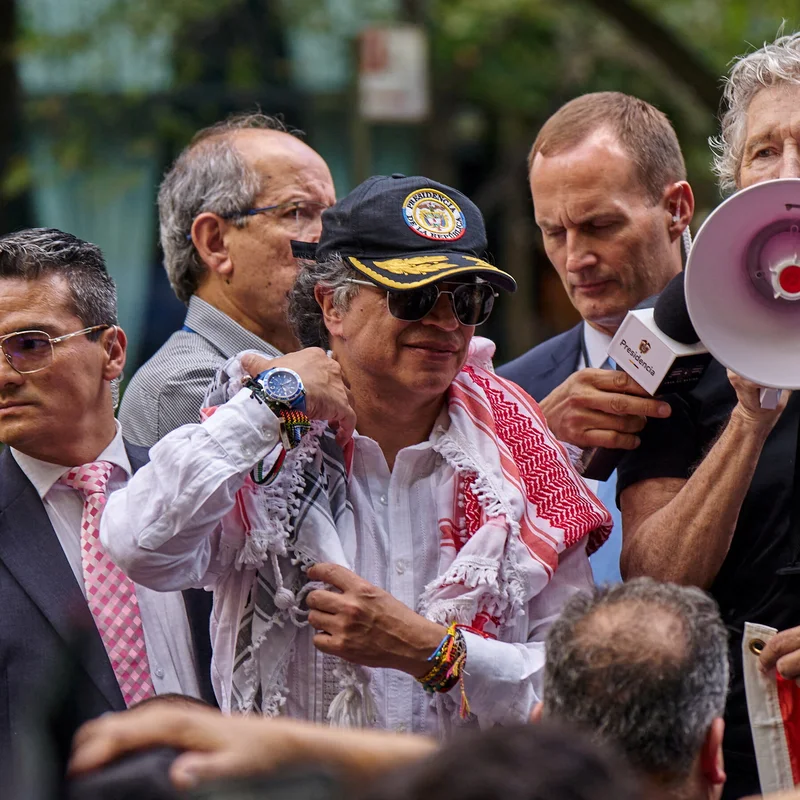
In a dramatic escalation of diplomatic tensions, the United States has announced it will revoke the visa of Colombian President Gustavo Petro following his inflammatory remarks at a pro-Palestinian rally in New York. The State Department labeled Petro’s comments “reckless” and a direct challenge to U.S. military authority .
What Did President Petro Say?
Speaking before thousands of demonstrators near the United Nations, President Petro called for the creation of a “global armed force bigger than that of the United States” to liberate Palestinians . More provocatively, he urged American soldiers to disobey orders from former President Donald Trump, who has signaled a hardline stance on Gaza should he return to office .
His exact words—“Viva Palestina!”—echoed through the crowd as he led chants, cementing his position as one of the most vocal Latin American leaders in support of Palestine .
U.S. Response: A Diplomatic Earthquake
The Biden administration reacted swiftly. In an official statement, the State Department declared:
“President Petro’s call for U.S. service members to defy their commander-in-chief is not only irresponsible—it undermines the foundational principles of military discipline and democratic governance.”
This move marks a significant rupture in historically strong U.S.-Colombia relations, which have spanned over two centuries .
Timeline of Escalating Tensions
- January 2025: Petro refuses to host a U.S. military delegation .
- June 2025: U.S. and Colombia recall their ambassadors amid an alleged plot and growing ideological rift .
- July 2025: U.S. imposes new tariffs on Colombian coffee and flower exports .
- September 27, 2025: U.S. announces visa revocation for President Petro .
Economic Fallout: By the Numbers
The diplomatic chill is already impacting trade and investment:
| Metric | 2024 | 2025 (YTD) | Change |
|---|---|---|---|
| U.S. FDI in Colombia | $4.2B | $1.8B | ↓ 15% |
| U.S.-Colombia Trade Balance (July) | +$28M | +$33.1M | ↑ Slight surplus |
| Colombian Exports to U.S. (Key Sectors) | Coffee, Flowers, Oil | Disrupted by tariffs | ↓ Market volatility |
What This Means for North American Policy
For U.S. policymakers and businesses, the rift with Colombia—a key ally in Latin America—raises concerns about regional stability, counter-narcotics cooperation, and migration management . The breakdown also complicates efforts to counter Chinese and Russian influence in the region .
Analysts warn that Petro’s push for “strategic autonomy” may accelerate Colombia’s pivot toward non-Western partners .
Key Stakeholders Affected
National security, foreign policy credibility, and hemispheric leadership at stake.
Potential economic slowdown, reduced foreign investment, and diplomatic isolation.
Watching closely as a test case of U.S. tolerance for dissent among allies.
Looking Ahead
While the visa revocation is largely symbolic—Petro rarely travels to the U.S.—it signals a deep ideological chasm. Rebuilding trust will require high-level dialogue and compromise on issues ranging from Palestine to military cooperation.
For more on U.S. foreign policy in Latin America, see our in-depth analysis on [INTERNAL_LINK:U.S.-Latin America relations].
For an authoritative overview of U.S.-Colombia relations, refer to the U.S. Department of State’s official page.
Sources
- https://www.nytimes.com/2025/09/27/us/colombia-petro-visa-palestine.html
- https://www.bbc.com/news/world-latin-america-73849201
- https://apnews.com/article/colombia-petro-us-visa-palestine-trump-8f3a9b2c1d4e5f6a7b8c9d0e1f2a3b4c
- https://www.state.gov/u-s-relations-with-colombia/
- https://www.csis.org/analysis/us-colombia-relations-facing-key-decision-points
- https://www.reuters.com/world/americas/us-colombia-recall-envoys-diplomatic-rift-deepens-2025-07-04/