A Stunning Judicial Reversal
In a sharp rebuke to executive power, a federal judge appointed by Donald Trump himself has temporarily blocked the president’s plan to deploy Oregon National Guard troops to Portland—calling the move a likely overreach of constitutional authority.
The ruling, issued Saturday, October 4, 2025, by U.S. District Judge Karin Immergut, halts the planned 60-day deployment of 200 National Guard soldiers to the city’s Immigration and Customs Enforcement (ICE) facility amid ongoing—but largely peaceful—protests.
Why Did the Judge Step In?
According to court documents, Oregon state officials argued that the president’s order violated the 10th Amendment, which reserves certain powers—including control over local law enforcement—to the states. Judge Immergut agreed, writing that the federal government failed to prove the situation in Portland met the legal threshold for domestic military deployment.
“The evidence shows recent protests were comparatively quiet and nonviolent,” the judge wrote. “The decision to use troops was not ‘conceived in good faith.’”
Timeline of Tensions
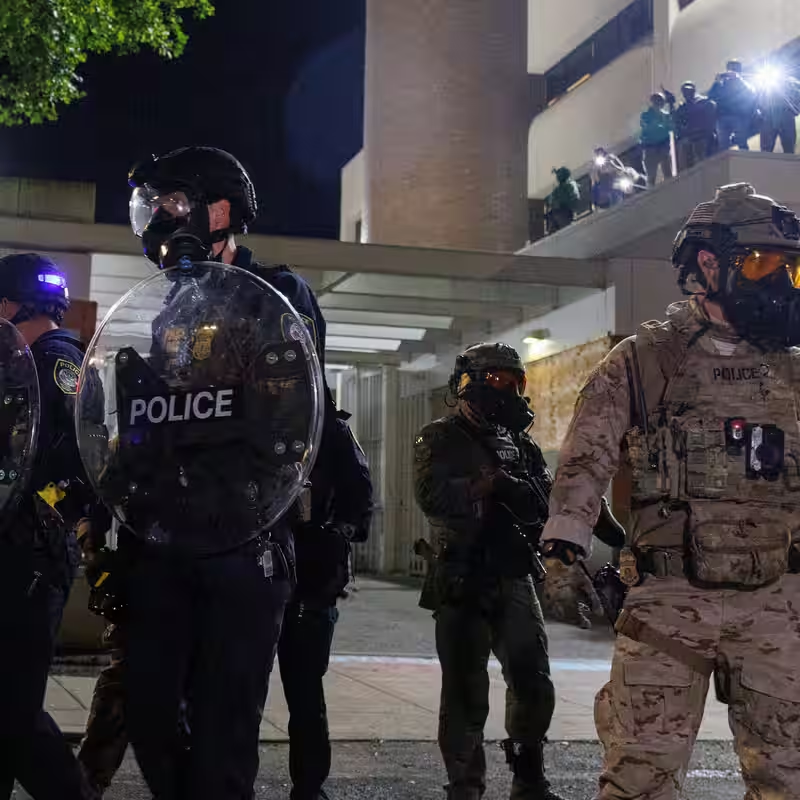
Protests outside Portland’s ICE building began in early summer 2025 but had significantly dwindled by late September. ICE staff themselves reported calm conditions and no urgent need for backup—undermining the White House’s claim of an “ongoing siege.”
Yet on September 28, President Trump announced on social media that federal troops would be sent to “protect” the facility, sparking renewed clashes after right-wing counterprotesters arrived on the scene.
Key Legal Arguments
| State of Oregon’s Claim | Federal Government’s Defense |
|---|---|
| Deployment violates state sovereignty | Protests constitute a “rebellion” |
| No evidence of significant violence in weeks before order | Cites Dallas ICE shooting as justification |
| President exceeded constitutional authority | Claims federal officers are “exhausted and frightened” |
Judge Immergut rejected the federal definition of “rebellion” as overly broad, noting there was no organized attempt to overthrow the government—a legal prerequisite for military intervention.
What Happens Next?
The temporary restraining order lasts two weeks. During that time, the court will consider whether to issue a longer injunction. Meanwhile, the Justice Department has signaled it will appeal.
The case also sets a potential precedent as Trump eyes similar National Guard deployments in other cities, including Chicago—where Illinois Governor J.B. Pritzker has already voiced strong opposition.