Table of Contents
- Supreme Court Stays Open Amid Federal Shutdown
- The Case: Chiles v. Salazar
- What Is Conversion Therapy?
- Free Speech vs. Professional Conduct
- Broader Implications for LGBTQ+ Youth
- What the Justices Are Watching
- Sources
Supreme Court Stays Open Amid Federal Shutdown
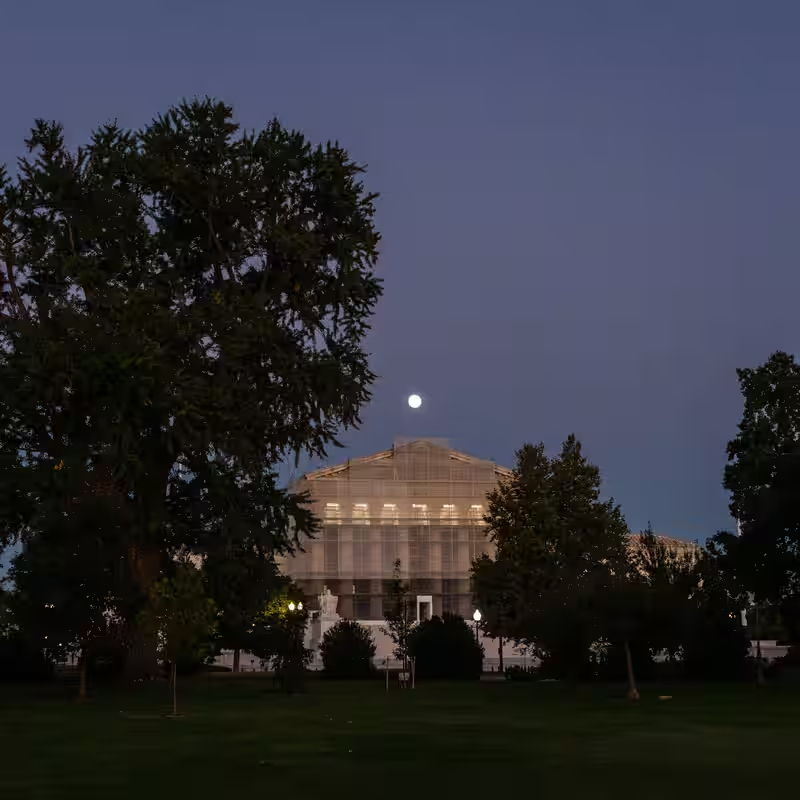
While much of the federal government grinds to a halt during the ongoing shutdown, one institution remains fully operational: the U.S. Supreme Court. On Tuesday, October 7, 2025, the justices convened as scheduled to hear oral arguments in Chiles v. Salazar—a high-stakes case challenging Colorado’s ban on conversion therapy for minors.
Thanks to permanent funding mechanisms not tied to annual appropriations, the Court continues its work uninterrupted. “The Supreme Court will rely on permanent funds… to maintain operations through the duration of short-term lapses,” a court spokeswoman confirmed.
The Case: Chiles v. Salazar
At the heart of the dispute is Kaley Chiles, a licensed therapist and evangelical Christian from Colorado Springs. Chiles argues that Colorado’s 2019 law—which prohibits mental health professionals from offering conversion therapy to anyone under 18—violates her First Amendment right to free speech.
Chiles insists she doesn’t seek to “cure” same-sex attraction but instead offers voluntary, faith-based counseling to minors who wish to align their lives with their religious beliefs. “I’m not trying to change anyone,” she told reporters. “I’m helping clients explore their own values.”
Colorado’s law, backed by major medical associations like the American Psychological Association, bans any practice aimed at changing a minor’s sexual orientation or gender identity. Violations can result in fines up to $5,000 and license suspension—but notably, the state has never enforced the statute.
What Is Conversion Therapy?
Conversion therapy refers to a range of discredited practices that attempt to change a person’s sexual orientation or gender identity. Historically, these included aversive techniques like electric shocks or nausea-inducing drugs. Today, most practitioners use talk therapy or cognitive behavioral methods—but medical experts still warn of serious psychological harm.
A 2019 UCLA Williams Institute study estimated that nearly 700,000 U.S. adults have undergone some form of conversion therapy—half before the age of 18. Despite bans in over 20 states, a 2023 Trevor Project report identified more than 1,300 licensed counselors still advertising such services, often under euphemisms like “sexual addiction counseling.”
States with Conversion Therapy Bans (as of 2025)
| Region | Number of States | Examples |
|---|---|---|
| West | 6 | California, Oregon, Washington |
| Northeast | 9 | New York, Massachusetts, Connecticut |
| Midwest/South | 7+ | Colorado, Illinois, New Jersey |
Free Speech vs. Professional Conduct
The central legal question before the Court is whether therapy constitutes protected speech or regulated professional conduct. If it’s speech, Colorado’s law faces strict scrutiny. If it’s conduct—even if delivered through words—the state can regulate it to protect public health.
This tension echoes the Court’s 2018 ruling in NIFLA v. Becerra, where Justice Clarence Thomas wrote: “Speech is not unprotected merely because it is uttered by ‘professionals.’” Yet the Court has also upheld regulations on medical practice, even when they affect what doctors say.
Broader Implications for LGBTQ+ Youth
A ruling in Chiles’s favor could invalidate similar bans nationwide, potentially exposing thousands of LGBTQ+ minors to harmful practices. Advocates warn that even “voluntary” therapy can reinforce shame and increase suicide risk—especially among teens already struggling with identity.
“This isn’t about censorship,” said Dr. Maya Lin of the Trevor Project. “It’s about preventing documented harm to vulnerable young people.”
What the Justices Are Watching
The case arrives just months after the Court upheld Tennessee’s ban on gender-affirming care for minors in U.S. v. Skrmetti. There, Chief Justice John Roberts emphasized that such “thorny questions” should be resolved through “the democratic process.”
Now, the Court must decide whether elected lawmakers have the authority to shield minors from therapies deemed dangerous by medical consensus—or whether individual therapists’ speech rights override public health concerns.
With a conservative majority that has recently sided with religious objectors in cases involving LGBTQ+ rights, the outcome remains uncertain—but the stakes for conversion therapy bans across America couldn’t be higher.