Table of Contents
- The Rise of a Legal Strategist
- The Landmark Case: Trump v. United States
- From Missouri to the Nation’s Top Lawyer
- What Does the Solicitor General Do?
- The Future of Presidential Power
- Sources
The Rise of a Legal Strategist
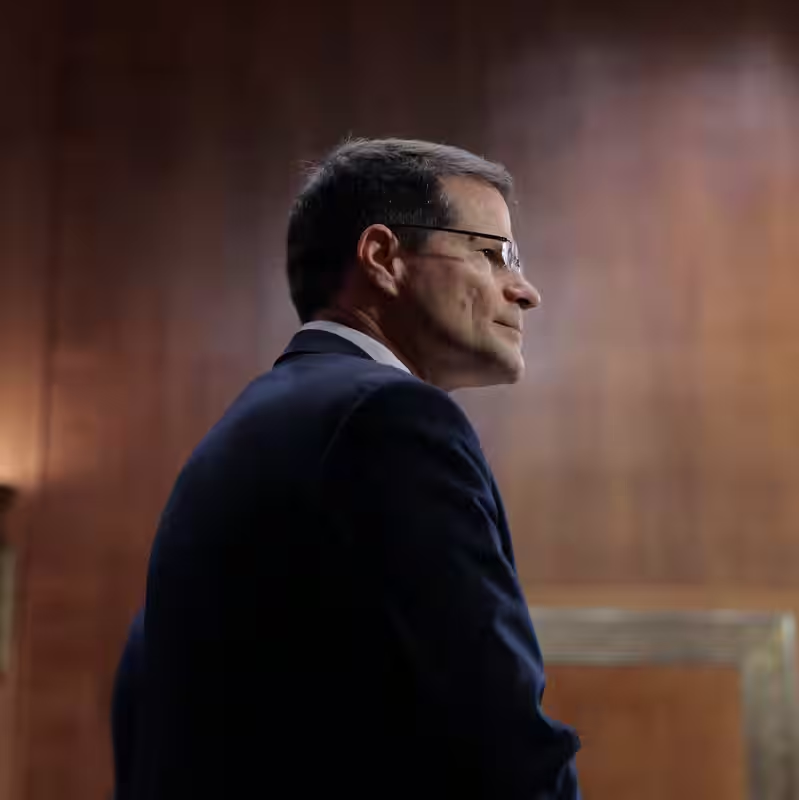
In the high-stakes world of constitutional law, few names have become as pivotal in recent years as D. John Sauer. Once a relatively unknown figure outside legal circles, Sauer has now cemented his legacy as the architect behind one of the most significant expansions of presidential power in modern American history. His journey from the Missouri Attorney General’s office to the inner sanctum of Donald Trump’s legal team is a story of legal acumen, strategic brilliance, and unwavering loyalty.
The Landmark Case: Trump v. United States
The defining moment of Sauer’s career came in 2024 when he stood before the U.S. Supreme Court as the lead counsel for former President Donald Trump in the case of Trump v. United States. The stakes couldn’t have been higher: the case centered on the question of whether a former president could be criminally prosecuted for official acts performed while in office.
Sauer’s argument was bold and sweeping. He successfully convinced the Court’s conservative majority to extend broad immunity to Trump, a victory that has fundamentally reshaped the legal landscape for the presidency. This wasn’t just a win for his client; it was a seismic shift in the balance of power between the executive branch and the judiciary. As Trump himself noted, Sauer was the lead counsel in this “Historic Victory on Presidential Immunity” .
Key Arguments in Trump v. United States
| Sauer’s Argument | Outcome |
|---|---|
| Presidents need absolute freedom to perform official duties without fear of prosecution. | Supreme Court granted broad immunity for official acts. |
| Criminal prosecution of a former president for official acts would cripple the executive branch. | Court agreed, establishing a strong precedent for future presidents. |
From Missouri to the Nation’s Top Lawyer
Before his star turn on the national stage, Sauer built a formidable reputation as the Solicitor General of Missouri from 2017 to 2023 . In that role, he was a frequent advocate before the Supreme Court, often challenging federal regulations on issues ranging from environmental policy to administrative law . His track record of success in these complex cases made him a natural choice for Trump’s most critical legal battles.
On January 20, 2025, President Trump formally nominated Sauer to be the next U.S. Solicitor General—the federal government’s top lawyer before the Supreme Court, a position often dubbed the “10th justice” [[4], [8]]. This appointment was more than a promotion; it was a strategic masterstroke. By placing the very lawyer who had just secured him sweeping legal protections into the nation’s top legal advocacy role, Trump ensured that his vision for an empowered executive branch would be vigorously defended in every future courtroom battle.
What Does the Solicitor General Do?
The Solicitor General is responsible for representing the federal government in cases before the Supreme Court and for deciding when the government should file amicus briefs in lower court cases . It’s a role that requires not just legal expertise, but a deep understanding of the administration’s policy goals. For the Trump administration, with its focus on deregulation and executive authority, Sauer is the perfect fit. His prior work fighting against federal climate rules in court is a clear indicator of the legal battles to come .
The Future of Presidential Power
D. John Sauer’s influence extends far beyond a single court victory. By successfully arguing for broad presidential immunity, he has laid the groundwork for a new era of executive power. The precedent set in Trump v. United States will be cited for decades, shaping how future presidents govern and how the courts hold them accountable.
Now, from his powerful new perch as Solicitor General, Sauer is uniquely positioned to deploy this very power on behalf of the administration that he helped to legally fortify. The lawyer who secured the shield is now the one who wields the sword.