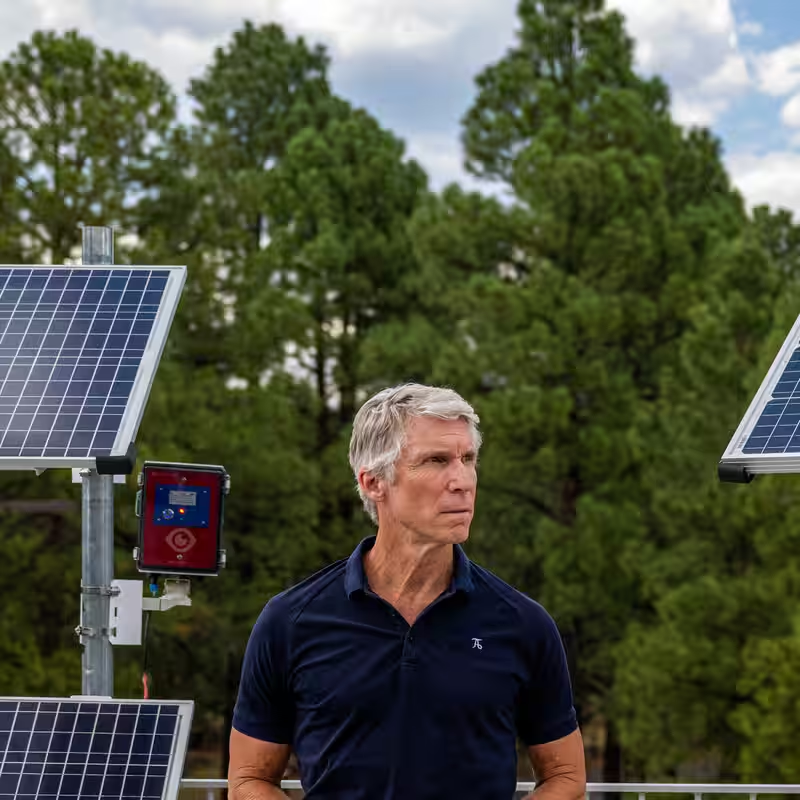
For over 15 years, atmospheric scientist Dr. Kevin Gurney led groundbreaking work to map how greenhouse gas emissions are supercharging urban heat across America. His mission was urgent and deeply human: “Fundamentally, we were trying to learn about these systems to prevent people from dying unnecessarily from heat.” But in June 2025, that mission came to a sudden halt—when the Trump administration canceled all three of his federal research grants in a single month.
How Emissions Are Heating U.S. Cities: The Science That Got Silenced
How emissions are heating U.S. cities isn’t just a climate talking point—it’s a public health emergency. Dr. Gurney’s work revealed that urban areas like Los Angeles, Indianapolis, and Baltimore are becoming dangerous heat traps, not only due to global warming but also because of local emissions from traffic, industry, and energy use. These emissions intensify the “urban heat island” effect, where concrete, asphalt, and lack of green space cause city temperatures to soar 10–15°F higher than surrounding rural areas.
“Climate change used to feel distant—polar bears, melting ice,” Gurney said in a recent interview. “But emissions are all around you. Every car you drive, every building you heat—it’s part of the system. We were making the invisible visible.”
Three Grants, One Devastating Blow
Gurney’s research relied on three key federal programs—all now defunded:
- NIST (National Institute of Standards and Technology): Funded a high-resolution greenhouse gas monitoring network using aircraft, cell towers, and ground sensors in three major U.S. cities. The goal: create a prototype “urban emissions observatory” to guide local climate policy.
- Department of Energy (DOE): Supported the Urban Integrated Field Laboratories, a national initiative studying extreme heat in cities. Gurney’s Southwest team focused on how infrastructure and emissions combine to put vulnerable populations—especially the elderly and low-income residents—at risk.
- NOAA: Though not formally canceled, this grant reached its end and was not renewed. It fed critical emissions data into national atmospheric models used for forecasting and policy.
Why This Research Mattered
Gurney’s work wasn’t abstract science—it had real-world impact. By pinpointing exact emission sources block by block, cities could:
- Target tree-planting and cool-roof programs in the hottest neighborhoods.
- Redirect emergency cooling resources during heatwaves.
- Evaluate the real impact of clean energy policies like electric buses or building retrofits.
“You cannot manage what you don’t measure,” Gurney often said. Without precise urban emissions data, cities are flying blind during climate emergencies.
Table: Urban Heat Risks Without Emissions Monitoring
| Risk Factor | Impact Without Data |
|---|---|
| Heatwave Response | Emergency services can’t prioritize high-risk zones |
| Infrastructure Planning | Cities invest in cooling solutions based on guesswork |
| Public Health | Heat-related deaths rise, especially among elderly and children |
| Climate Accountability | No way to verify if local emissions pledges are working |
A Pattern of “Lost Science”
Gurney’s case is part of a broader trend. Since early 2025, the Trump administration has systematically defunded climate research deemed “non-essential,” particularly projects linking emissions to public health or environmental justice. Scientists call it “research chilling”—where politically inconvenient science is quietly erased.
“This wasn’t just my lab,” Gurney said. “It was a national capability. And now it’s gone.”
Colleagues warn the U.S. is falling behind global peers. The European Union and China are expanding urban emissions monitoring, while America dismantles its own systems.
What’s Next for Urban Climate Safety?
Some cities are trying to fill the gap with private partnerships and university collaborations, but without federal coordination, data remains fragmented and inconsistent.
Gurney remains hopeful but realistic: “The science is still needed. The people are still at risk. Someone, somewhere, will have to pick this up—because lives depend on it.”
Until then, as summer temperatures climb and heatwaves grow deadlier, America’s cities are losing their best tool to fight back: the truth about their own emissions.