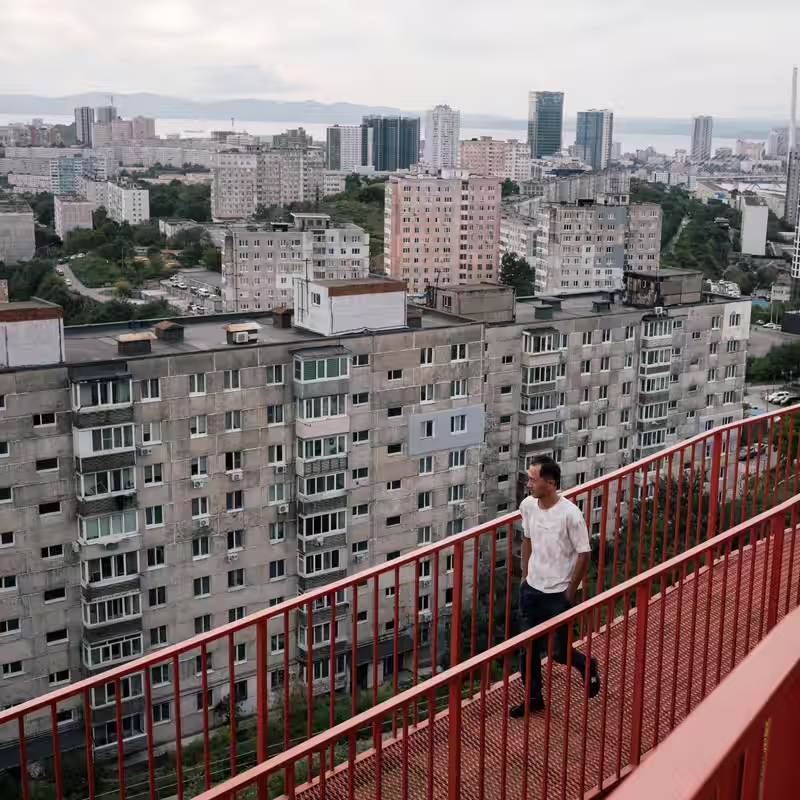
Vladivostok sits on Russia’s Pacific edge—a city of steep hills, bustling docks, and dreams of becoming Asia’s next great trade hub. Yet despite its geographic distance from the Kremlin, it remains tightly leashed by Moscow’s political grip, revealing the paradox at the heart of Russia’s vast empire: ambition without autonomy.
A City Built for Global Trade—Held Back by Central Control
Founded in 1860 as a naval outpost, Vladivostok was once envisioned as Russia’s “window to Asia.” Strategically positioned just 500 miles from Seoul and Tokyo, it hosts the country’s largest Pacific port and serves as the eastern terminus of the Trans-Siberian Railway.
For decades, local leaders have pushed to transform it into a free-trade zone, a tech corridor, even a Russian Singapore. But every major initiative—from customs reform to foreign investment incentives—requires approval from Moscow, where priorities are shaped by security concerns, not economic pragmatism.

The Kremlin’s Long Shadow
Since the full-scale invasion of Ukraine in 2022, Moscow’s control has only tightened. Western sanctions severed traditional trade routes, pushing Russia to pivot “East.” But instead of empowering regional hubs like Vladivostok, the Kremlin centralized decision-making even further.
“They talk about ‘turning to Asia,’ but all the real decisions are still made in Red Square,” said Elena Morozova, a logistics executive who moved her business from St. Petersburg to Vladivostok in 2023. “We get directives, not dialogue.”
Local elections are tightly managed. Independent media is scarce. And while the city hosts the annual Eastern Economic Forum—a showcase for Putin’s Asia strategy—few deals translate into real growth for residents.
Vladivostok vs. Moscow: A Tale of Two Priorities
| Issue | Vladivostok’s Need | Moscow’s Response |
|---|---|---|
| Trade Policy | Flexible tariffs, streamlined customs | Uniform national rules; security vetting slows imports |
| Foreign Investment | Open to Chinese, Korean, ASEAN capital | Heavy restrictions; fear of “foreign influence” |
| Infrastructure | Modernize port, expand rail capacity | Funding diverted to military logistics |
| Governance | Greater local autonomy | Appointed governor; no real devolution |
A City of Contradictions
Vladivostok’s skyline gleams with new university campuses and tech parks built for the 2012 APEC summit. Yet unemployment hovers near 9%, and young professionals routinely leave for Seoul, Bangkok, or even Siberian cities with better prospects.
“We’re told we’re Russia’s future in Asia,” said Anton, a 28-year-old software developer. “But our future feels like it’s being decided by people who’ve never seen the Pacific.”
[INTERNAL_LINK:Russian Regional Policy] experts say this tension reflects a deeper flaw in Putin’s system: a state that demands loyalty over innovation, control over competitiveness.
What’s Next for Russia’s Pacific Dream?
Without real decentralization, analysts argue, Vladivostok will remain a symbolic gateway—not a functional one. China, meanwhile, is investing heavily in its own Pacific ports, from Dalian to Hainan, quietly eclipsing Russia’s stalled ambitions.
For now, the city endures—a place of breathtaking views and unrealized potential, tethered to a capital 4,000 miles away that won’t let go.
Sources
The New York Times: “A Pacific Gateway Shows the Kremlin’s Grip on Russia’s Vast Expanse”