Once hailed as a trailblazer in the global green energy revolution, Danish offshore wind giant Orsted is now retreating from its international ambitions—cutting nearly a quarter of its workforce and pulling back from the United States amid mounting political and economic headwinds.
Table of Contents
- Crisis Unfolds: Why Orsted Is Downsizing
- Clash with the Trump Administration
- Financial Fallout and Strategic Retreat
- What Happens Next for Orsted?
- Broader Implications for Renewable Energy
- Sources
Crisis Unfolds: Why Orsted Is Downsizing
On Thursday, October 9, 2025, Orsted announced it would eliminate approximately 2,000 jobs—around 25% of its global staff—by the end of 2027. The company, which employs roughly 8,000 people worldwide, plans to shrink to a leaner 6,000-employee operation focused primarily on its European core.
CEO Rasmus Errboe described the decision as painful but necessary: “We’ll be saying goodbye to many skilled and valued colleagues.” The cuts will come through a mix of layoffs (about 500 in Q4 2025 alone), attrition, outsourcing, and divestitures of business units.
Clash with the Trump Administration
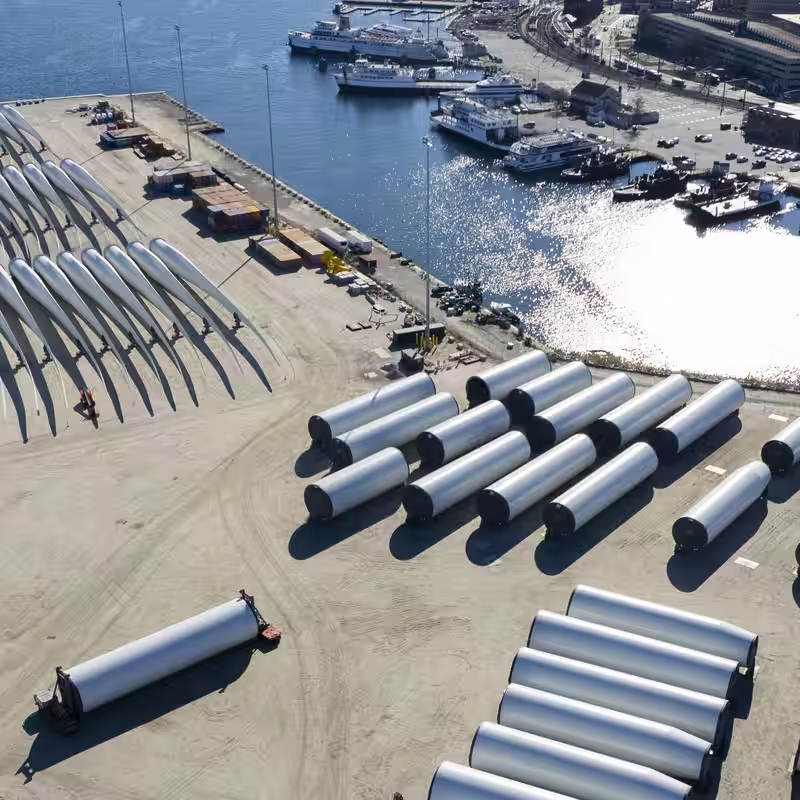
A major catalyst for Orsted’s retreat is the Trump administration’s aggressive opposition to offshore wind development along the U.S. East Coast. Earlier in 2025, the White House ordered an abrupt halt to Orsted’s Revolution Wind project—a $6.2 billion initiative off Rhode Island that was already 80% complete.
Although a federal judge recently cleared the way for construction to resume, the damage was done. Regulatory uncertainty, coupled with soaring costs from inflation and high interest rates, has made U.S. projects financially untenable.
Orsted’s Sunrise Wind project off New York also now faces an uncertain future, with no clear path to long-term viability under the current political climate.
Financial Fallout and Strategic Retreat
Just a few years ago, Orsted was expanding rapidly across the Atlantic, positioning itself as a global leader in renewable infrastructure. Today, the narrative has flipped. The company recently raised over $9 billion in emergency capital—including a major injection from the Danish government, which owns just over 50% of Orsted’s shares.
| Metric | Before 2025 | Projected by End of 2027 |
|---|---|---|
| Global Employees | ~8,000 | ~6,000 |
| U.S. Projects Active | Multiple (incl. Revolution & Sunrise) | Limited to completion only |
| Strategic Focus | Global expansion | European consolidation |
What Happens Next for Orsted?
Orsted isn’t exiting the U.S. overnight—it will finish current builds—but it has shelved all new American developments. The company’s revised strategy centers on survival, not growth, with Europe as its safe harbor.
Analysts like Deepa Venkateswaran of Bernstein Research note that “the last couple of years have changed everything for them.” What was once a high-growth green energy darling is now in damage-control mode.
Broader Implications for Renewable Energy
Orsted’s struggles highlight a sobering reality: even the most advanced renewable technologies are vulnerable to political volatility, supply chain shocks, and macroeconomic turbulence. The offshore wind sector—once seen as a cornerstone of the clean energy transition—is losing momentum in key markets.
For policymakers and investors, Orsted’s pivot is a warning: without stable regulatory frameworks and long-term policy support, the green transition could stall just when it’s needed most.