Table of Contents
- California’s Wildfire Crisis: A New Normal?
- The Palisades Fire: Arson, Not Accident
- The 7 Most Destructive California Wildfires—And What Caused Them
- How Climate Change Fuels the Firestorm
- Humans: The Unintended (and Intentional) Ignition Source
- What Can Be Done to Prevent the Next Inferno?
- Sources
California’s Wildfire Crisis: A New Normal?
California wildfires have grown increasingly catastrophic over the past two decades—but not all blazes start the same way. While some are sparked by lightning or drought-ravaged vegetation, others trace back to human hands, whether through negligence or deliberate acts.
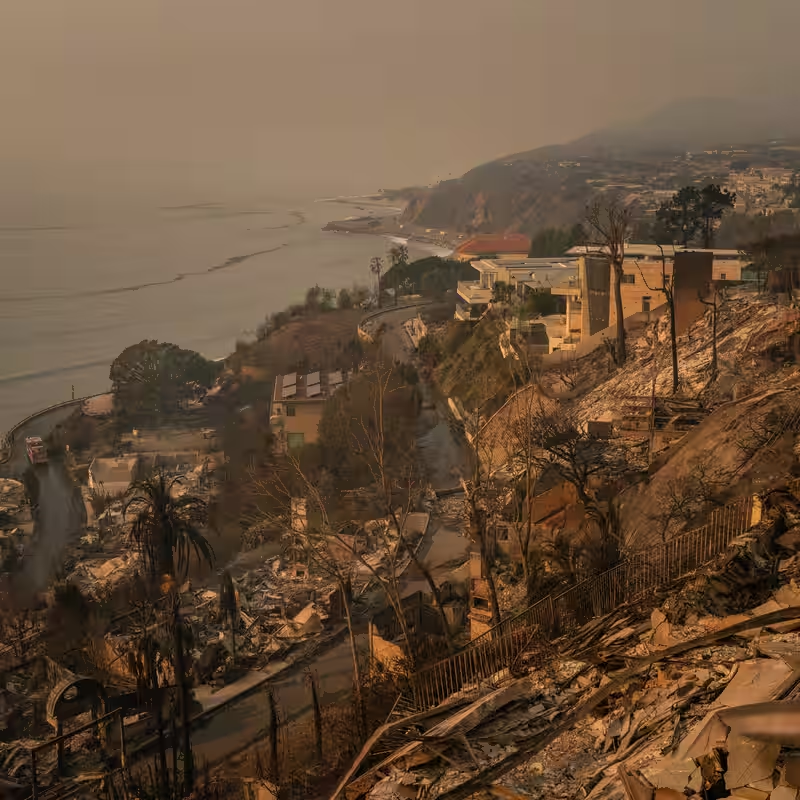
Recent investigations have revealed unsettling truths about the origins of the state’s most destructive fires, including the January 2025 Palisades fire that killed 12 people and reduced thousands of Pacific Palisades homes to ash.
The Palisades Fire: Arson, Not Accident
Federal officials confirmed this week that the Palisades fire originated from a small blaze intentionally set on January 1 by a 29-year-old man described as “obsessed with fire.” That initial flame smoldered before reigniting on January 7 amid fierce Santa Ana winds—merging with the Eaton fire to create one of the worst wildfire events in Los Angeles history.
Unlike natural ignitions, this fire was preventable—and its human origin underscores a troubling trend: as urban areas expand into wildlands, the risk of human-caused ignition rises dramatically.
The 7 Most Destructive California Wildfires—And What Caused Them
According to the California Department of Forestry and Fire Protection (CAL FIRE), the causes of the state’s deadliest fires vary widely:
| Fire Name | Year | Acres Burned | Cause |
|---|---|---|---|
| Camp Fire | 2018 | 153,336 | PG&E power lines |
| Palisades Fire | 2025 | 15,000+ | Arson (human-set) |
| Thomas Fire | 2017 | 281,893 | Power equipment |
| Cedar Fire | 2003 | 273,246 | Signal fire gone wrong |
| Woolsey Fire | 2018 | 96,949 | Power infrastructure |
| Dixie Fire | 2021 | 963,309 | PG&E equipment |
| Eaton Fire | 2025 | 12,000+ | Under investigation (likely human) |
How Climate Change Fuels the Firestorm
“If there is fuel and there is ignition, you’re going to get fire,” said William Deverell, a USC professor studying wildfire history in the West. Climate change has supercharged both elements: hotter temperatures dry out vegetation, turning forests and grasslands into tinderboxes, while stronger, more erratic winds spread flames faster than ever.
What once was a seasonal threat now lingers year-round. “We’re seeing fire behavior in winter that used to only happen in August,” said one CAL FIRE battalion chief.
Humans: The Unintended (and Intentional) Ignition Source
Experts estimate that nearly 90% of wildfires in California are human-caused—whether from downed power lines, discarded cigarettes, campfires left unattended, or, as in the Palisades case, deliberate arson.
“Humans create a lot of spark, whether intentionally or not,” Deverell noted. As communities push deeper into fire-prone zones—known as the wildland-urban interface—the consequences become more deadly.
What Can Be Done to Prevent the Next Inferno?
Solutions require a multi-pronged approach:
- Hardening infrastructure: Burying power lines, upgrading transformers.
- Controlled burns: Reducing fuel loads through prescribed fire.
- Stricter land-use policies: Limiting development in high-risk zones.
- Public awareness: Educating residents on fire-safe practices.
But without addressing the root driver—climate change—experts warn that even the best prevention may not be enough.
Sources
The New York Times: What Ignited California’s Most Destructive Fires
CAL FIRE: Official Incident Reports
USC Wildfire History Project – Dr. William Deverell